
Coda
Material Space 6

Sharing Things
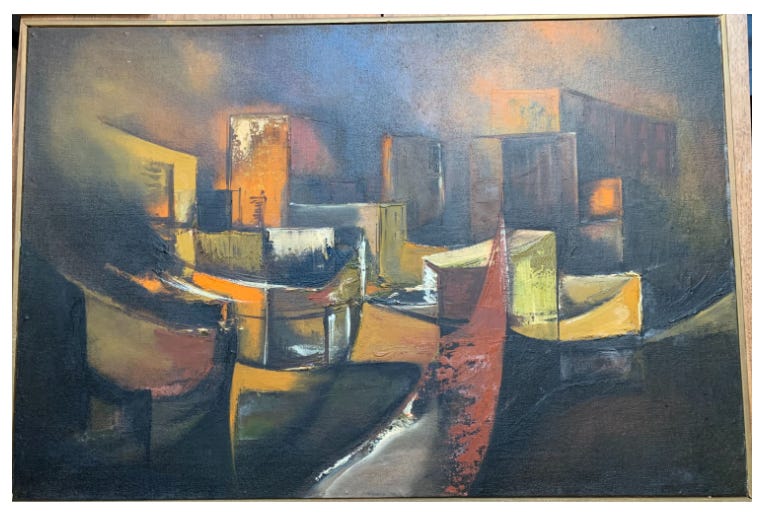
One way that we learn is from the things we have scattered around our rooms. We are living in a small fourth-floor walkup in Boston’s South End. The apartment is at the top of the building and puts us close to the sky. We bring things home from our walks. Things in small pieces and cuttings that people have discarded. Having these things in the periphery of awareness infiltrates and shapes our thought in ways we do not understand. These notes are without the images that they are meant to describe. This frees them from intent, with one exception, a painting by Brenda Wallace that I had on my wall growing up.
[Hour Glass] I am not sure where this hour glass came from but it has become an important part of my mornings. I turn the glass when I wake up and let the grey sand begin to trickle down. By May there is usually some light and a tracing of bird song in the air by the time the sand is at the bottom of the glass. It is not quite an hourglass. It runs through a cycle in about 49 to 53 minutes. I am not sure what causes the variation, perhaps humidity.
[Red Cabbage] Our apartment is full of the ends of things --- bits of wire, cloth scraps, notes with a few words, bike parts, whatevers. There are the slowly drying roots of foods we eat. The white rootlets of green onions are lined up along the mantle along with the roots from a couple of heads of red cabbage, several months old by now. The cabbage roots are dry and a bit brittle, the way in which the leaves join the stem can be seen much better than when we were eating this in fall salads.
[Wallace] This painting from my childhood is by Brenda Wallace, a close friend of my mother’s. I grew up dreaming about these shapes. It is on the bookshelf above the hourglass. The cloaked forms give depth to the wall.
(See top image for this post)
[Sink] Most weekends Yoshie and I will go for a long walk somewhere around Boston. We often take a train to get out of the city and see the small New England towns that are so much the social fabric of Massachusetts. I ride through many of the same towns on longer bike rides. This crushed tin can was picked up on the road from Brockton station to the Fuller Craft Museum. I pinned the shoe insert underneath it to remind us of the walk. It is in the sink as it came with a lot of dirt and is still leaking.
[Rope] Anything that reminds one of the sea and its wrack is good. We found this piece of rope on the beach at Rockport on Cape Anne. For some reason it makes me think of Richard Serra’s work. It brings back memories of sailing trips. Once, many years ago, we were motoring south outside of Tokyo Bay in a thick fog and a dead calm, skirting the coast of the Chiba peninsula to stay out of the shipping lanes. We fowled a large water-logged cable, and I spent half an hour in the April ocean with a knife cutting us clear. That was as cold as I ever need to be. The rope on our wall, with its frayed ends and faint sea stink, has two tight splices, quite well done, the work of strong hands.
[Work Desk] She works with her hands, there are usually small examples of her work here and there on the table or counters. The main work desk is covered with tools. Small pliers and hammers, scissors, files, crochet hooks and the materials she works with – industrial paper and packing materials, wires, bits of plastic, small beads and strange little plastic knick-knacks in well organised patterns. The hand and touch shape the mind.
[Wall] Sometimes she hangs her work on the wall. Some of the work is with found objects. It includes egg cups, old gold brocade, and knit wire forms. It is not part of the wall but the wall begins to be part of the work.
[Fishing Gear] This yellow construction was also picked up on the shore of Cape Anne on a trip soon after we moved to Boston. I think it broke off a piece of fishing equipment. Cape Anne is important to us for its association with the poet Charles Olson, who lived many of his most productive years in the major fishing port of Gloucester. We use it to prop the back door open (the door opens onto a deck some fifty feet above the back gardens, level with the treetops). Sometimes I bring this piece of scrap to the table and keep it by me as I work. The worn yellow with corrosion showing through, the repeated cubes, the combination of past use and present, what, something anyway, helps me to focus and keep going. The sea is a hard way, and people who fish have more knowledge and make a harder effort at greater risk than most of us. This piece of scrap, picked from the rocks with a large sea running, seems to me as important as any work I am likely to do.
And that is the end of the recovered manuscript for Material Space.
Material Space 1 An Empty Room and Calls This
Material Space 2 Winter Yellow
Material Space 3 Shawled
Material Space 4 Material Space
Material Space 5 Burnt and Continuities
Material Space 6 Coda
I like how this line, "Having these things in the periphery of awareness infiltrates and shapes our thought in ways we do not understand," reverberates with the opening lines of George Oppen's Of Being Numerous: "There are things / We live among and to see them / Is to know ourselves."