
Flat ontologies
The equality of dependent origination


As though … 3 by Wang Jianwei, image from White Rabbit Gallery
“I cannot speak for the work of art because, now that it has come into being, we are equal and it possesses more characteristics than I know. I am only sure about one thing - my work hinges on the fact that I can never exhaust its existence.”
Wang Jiamwei 汪建伟 translated by Gao Yubing 高语冰 in Always, Owned By What We Own.
A flat ontology.
All things are contingent, not all conscious things, all things.
In Graham Harman’s words …
“"A flat ontology is one that allows countless layers of larger and smaller structures to have equal ontological dignity." (From Alien Theory (ATS, pp. 12–13))
and
"This first feature is the idea of 'flat ontology'. This means that all objects are equally objects, and above all that human beings are not different in kind from all non-humans, as if the universe were split into two basic types of things." From Philosophy Now (Issue 139, 2026)
Things go away from us as we go away from things. The expanding universe.
Real objects or Sensual objects …
Real objects exist autonomously and withdraw from every possible encounter — they can never be fully accessed, even by other non-human objects. Sensual objects, by contrast, have no independent existence; they arise only within a relation and exist only so long as that encounter lasts.
Is writing an attempt to complete the cycle from real object to sensual object and then back to the real?
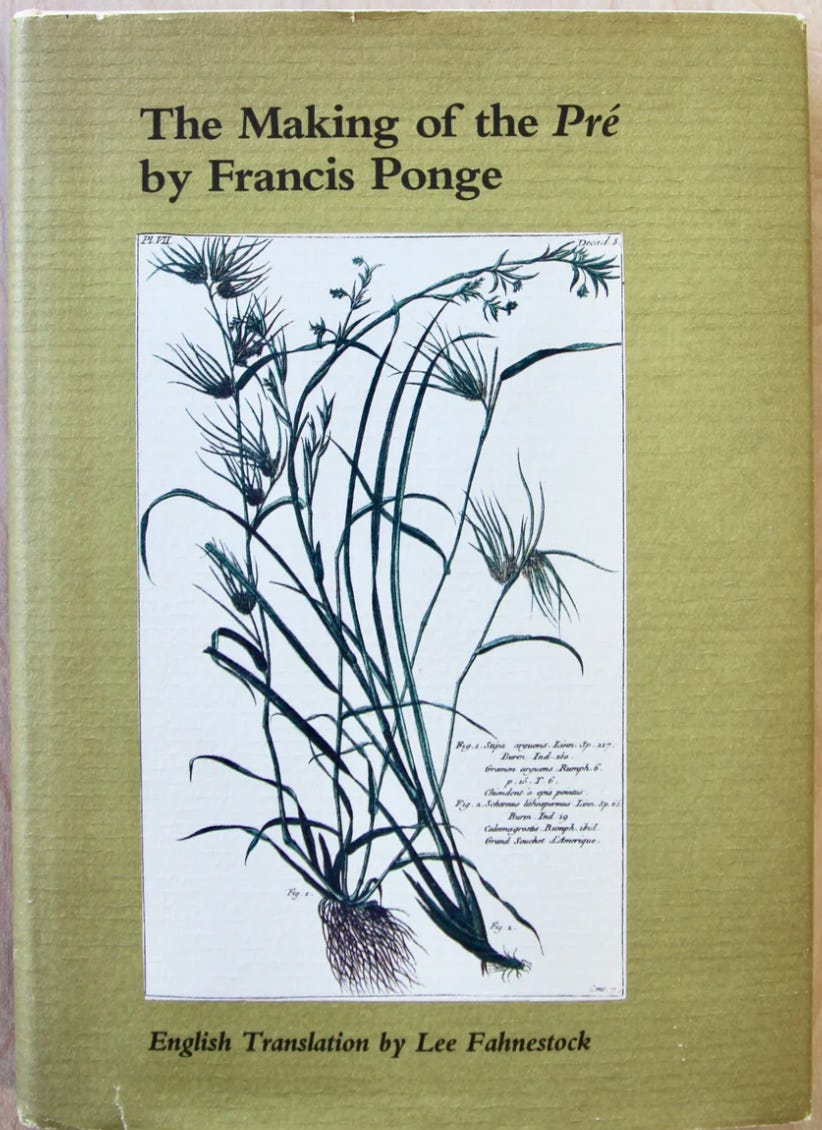
This is what Francis Ponge seems to be doing in his study The Making of the Pré. The book begins with the meadow outside Chambon-sur-Lignon in the Haute-Loire. “I was seized, I don’t know why, by a kind of secret, calm, pure enthusiasm. I immediately knew that this vision would remain as it was, intact in my memory. And therefore that I would have to try to say it.”
The ‘try to say it’ is the making of le Pré.
The book, published by the Swiss publisher Skira in 1971, has five layers.
“Les sentiers de la création” — a preambular essay in which Ponge reflects ironically on the title of the Skira collection itself (he dislikes the word “création,” preferring the Epicurean idea that nothing is created from nothing) and explains his decision to publish the dossier of the meadow.
La Fabrique du Pré (the dossier proper) — the chronological reproduction in facsimile of 91 manuscript and typescript folios, with their crossings-out, marginal notes, and interlinear additions.
Le Pré (the final poem) — the text as published in Tel Quel in 1964 and in Le Nouveau Recueil in 1967, printed on brown paper.
Transcription of the 91 folios — typed transcriptions of the facsimile pages, on green paper.
“Voici pourquoi j’ai vécu” — a closing manuscript page, written at “Les Fleurys” on the night of July 19–20, 1961, unrelated to the drafting of the meadow but placed as a kind of testament: “This is why I have lived… I have written. They have lived, I have lived”
From the meadow, to a long process of writing and rewriting, to a book that is itself something of a cult object. I read the translation by Lee Fahnestock, published by the University of Missouri Press in 1979, sometime in the early 1980s in Tokyo and have reread it many times since. The poem and the process seem to me a lived example of a flat ontology. The object (the meadow) shapes the text and the two come together in a lavishly illustrated book. Ponge is also the author of other books that speak to an equal ontology of objects, such as his first book Le parti pris des choses (Taking the side of things) and Soap.
My own notes are often sourced from objects.
Thread 1
Imperceptible
Line of water at body
Temperature fades
—
Any absolute boundary
Vanishes with the object
It contains
—
Boundaries
Porous as song in
Morning light
—
The water is water
Before any part of the water
Is water
—
The sky exists
Before the parts
It divides into
—
The sky has
No atomic parts
Or meaning
—
The rationals being
A dense subset of the reals
As a stone is to water
—
The square root of two
Is the actual value defined
By what it is
—
A part contains as
Many members as the
Whole contains itself
—
Empty of nothing
The water foams and subsides
Back into its form
—
Working to maintain
A first for things of
Dependent origination
—
Light on water
Conforms to itself without
Anything else
Thread 2
Water some snow
Then tea waiting for
The tannins colour
—
Old tea steeped
Leaf brown the tannins
Contract and bind
—
How the scent of tea
Changes as it steeps
That loss
—
The rationals being
A dense subset of the reals
As a stone is to water
—
Not knowing how to
Read the waters surface slides
All over itself
—
Not knowing how to
Read the bud unfolding as
A leaf inside time
—
Not knowing how to
Read her eyes watching what I
Am watching with her
—
The water surface
Flat as oil waiting for
The first breath of air
—
The flat water does
Not contain waves potential
Subsides into pull
—
The water empty
Of its tensions sliding
Into its surfaces
—
Incense makes
No sound as it burns
The trace remains
—
Coriander leaf
Dark purple inside with
Bitter high tones
—
Rain through sunlight
Vertical intent constrains
Light into gravity
—
Sunlight through rain
Filtered clear contains
Its own origination
—
Sand washed from
A bed of shell and stone
Concentrates
Thread 3
The old dog wakes up
Knows the world is still here
He is still here
—
The words need
Mean no more than what
They try to say
—
Mist caught in the valley
Trees the invisible
Becoming visible
Works referenced
Harman, Graham (2018) Object-Oriented Ontology: A New Theory of Everything. Pelican, London.
Ponge, Francis (1942) Le parti prix des choses translated as The Nature of Things by Lee Fahnestock. Reddust.
Ponge, Francis (1967) Le savon translated as Soap by Lane Dunlop. Stanford University Press.
Ponge, Francis (1971) La Fabrique du Pré translated as The Making of the Pré by Lee Fahnestock. University of Missouri Press.
Wang Jiamwei 汪建伟 translated by Gao Yubing 高语冰 (2025) Always, Owned By What We Own. ACC Art Books.