
Freesias for Jocelyn
A birthday. gift

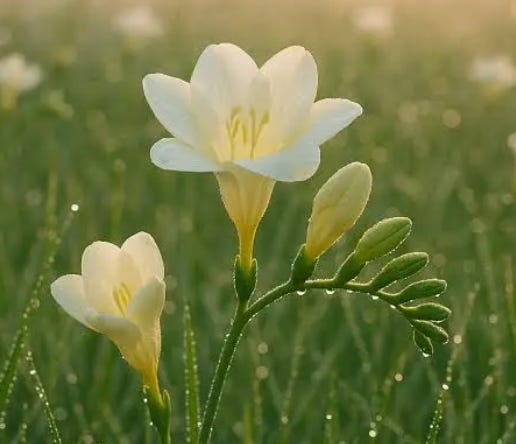
Freesias for Jocelyn
Plantings on an 8 x 5 grid
Take 1
Fragrant funnel shaped flowers from
A conical corm narrow leaved
And sparsely branched with six
Petalled flowers from Africa to
Our gardens planted in full
Sun to the south and
Well drained soil carrying memories
Of loving light not heat
Take 2
The flower of trust given
In honour of its fragrance
A floral burst deepening into
A peppery warmth that becomes
A heart note brightening with
Freshness receding into itself to
Become simply present as linalool
And ionomes distilled combined absorbed
Take 3
Imagine eight rows of five
Freesia like a grid of
White stars absorbing light into
Deep centers the sides closing
In containing stamen and anther
Yellow dusted with pollen and
Scent diffused in waves like
The sound of a trumpet softly
Zukofsky’s 80 Flowers in one of the most condensed pieces of writing ever written. It has haunted me over the thirty years I have been reading it. I was given a typescript by Cid Corman in Kyoto around 1984, the year my daughter was born.
The denser parts of A and 80 Flowers form a constellation with Paul Celan and some of the denser Tang dynasty poets, Du Fu 杜甫 or Bai Juyi 白居易. Fujiwara Shunzei 藤原 俊成 and especially Fujiwara Teika 藤原 定家 can also work like this. The layering of intention and references to other works make these short poems part of much larger structures. Zukofsky can condense a reference to an entire body of work into one word and then, through the roots, connect it to other flowerings.
There is a connection between this sort of density and objects. The word as object and words (language) intermingled with objects. That is how come into relation to each other. Surfacing then burying these relationships is how writing becomes a hyperobject in the sense used by Timothy Morton.
Eighty years old seemed like a distant future when I started to read these poems in my late 20s. An unattainable age that put these poems at a distance from me. That has changed over the years as the magic age of 80 draws closer and in my case seems somewhat unlikely. I want to celebrate my friends as they get to 80. This is the first in what I hope will become a series.
I am also going to use this to get closer into our gardens. The gardens, front and back, are a big part of my wife Yoshie’s art. There is a book about her back garden, photographed by three local photographers, and we may try to collaborate on something for the front. Gardens are four dimensional and cyclical. They cycle across the seasons and unfold across the years. That soudns like a good framing for these possible poems.
Atkins, Paul, S. (2017) Teika: The Life and Works of a Medieval Japanese Poet. University of Hawaii Press.
Celan, Paul translated by Pierre Joris (2011) The Meridian: Final Version―Drafts―Materials. Stanford University Press.
Leggott, Michele J. (1989) Reading Zukofsky’s 80 Flowers. The John Hopkins University Press.
Morton, Timothy (2013) Hyperobjects: Philosophy and Ecology after the End of the World. University of Minnesota Press
Zukofsky, Louis (1978) A. New Directions.
Zukofsky, Louis (1978) Anew: Complete Shorter Poetry (includes 80 Flowers). New Directions.