
Littoral
Writing in the margins

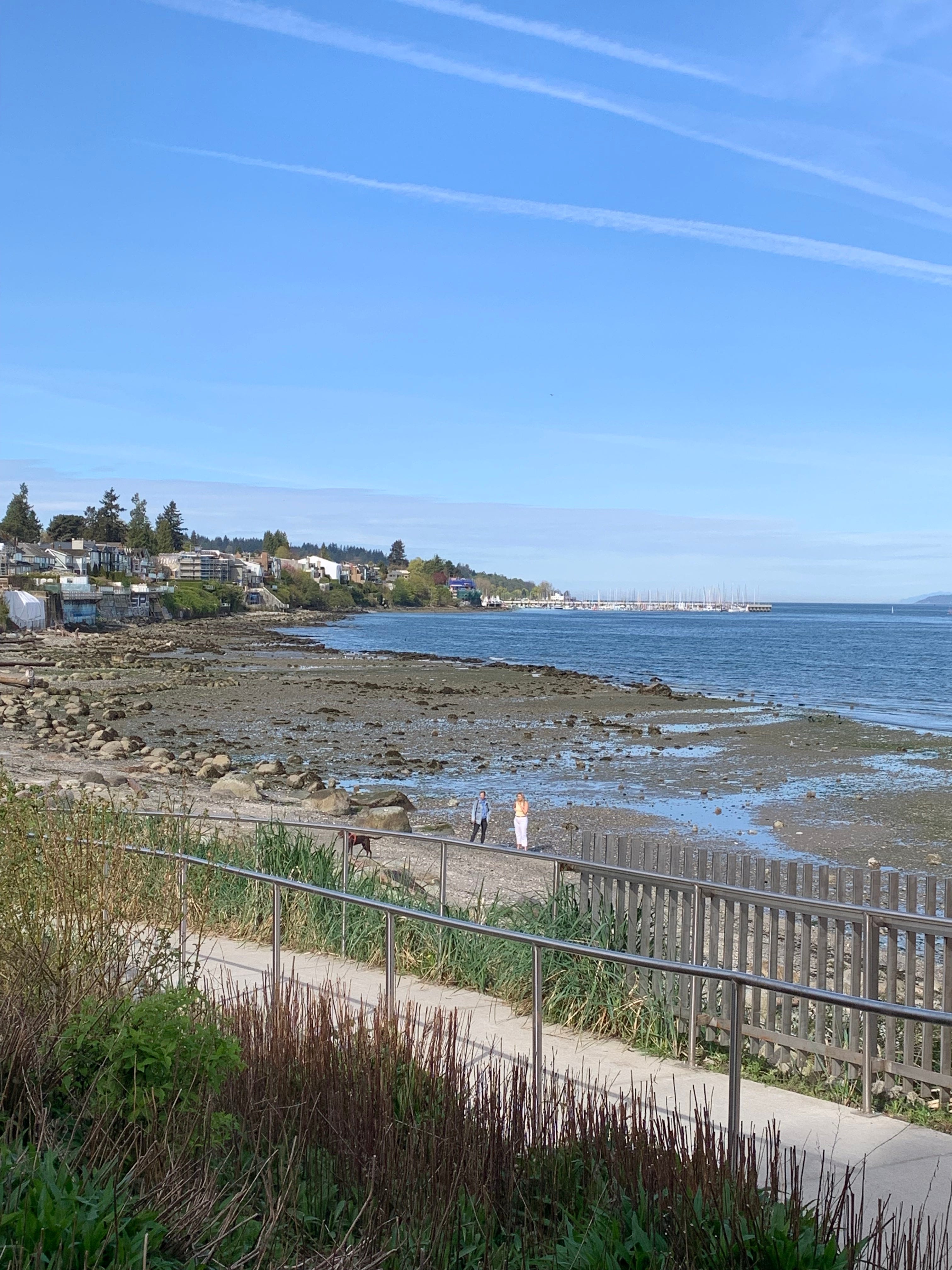
My littoral, looking West North West, at low tide.
For most of my life I was a deep water person. I preferred to be on a boat, away from shore. In Vancouver I spend more time in sea kayaks than on sailboats, and I like to paddle close to the shore, in the wave action, but still on the water.
In the past few years I have spent more time in the littoral,
The littoral zone lies between the low tide line and the high tide line. Life in the littoral zone needs to be creative to survive. At hight tide the zone is covered in water and sees a lot of current and wave action. At low tide it is exposed to the air and all sorts of new predators. Ways of life blur. Live in the water. Live in the air.
The littoral is also a site for art.
Richard Long in an interview with Mario Codognato (1997).
“On a beach in Cornwall in 1970 I made a spiral of seaweed below the tide line. I liked the idea my work, lasting only a tide, was interposed between past and future patterns of seaweed of infinite variation, made by natural and lunar forces, repeating for millions of years.”
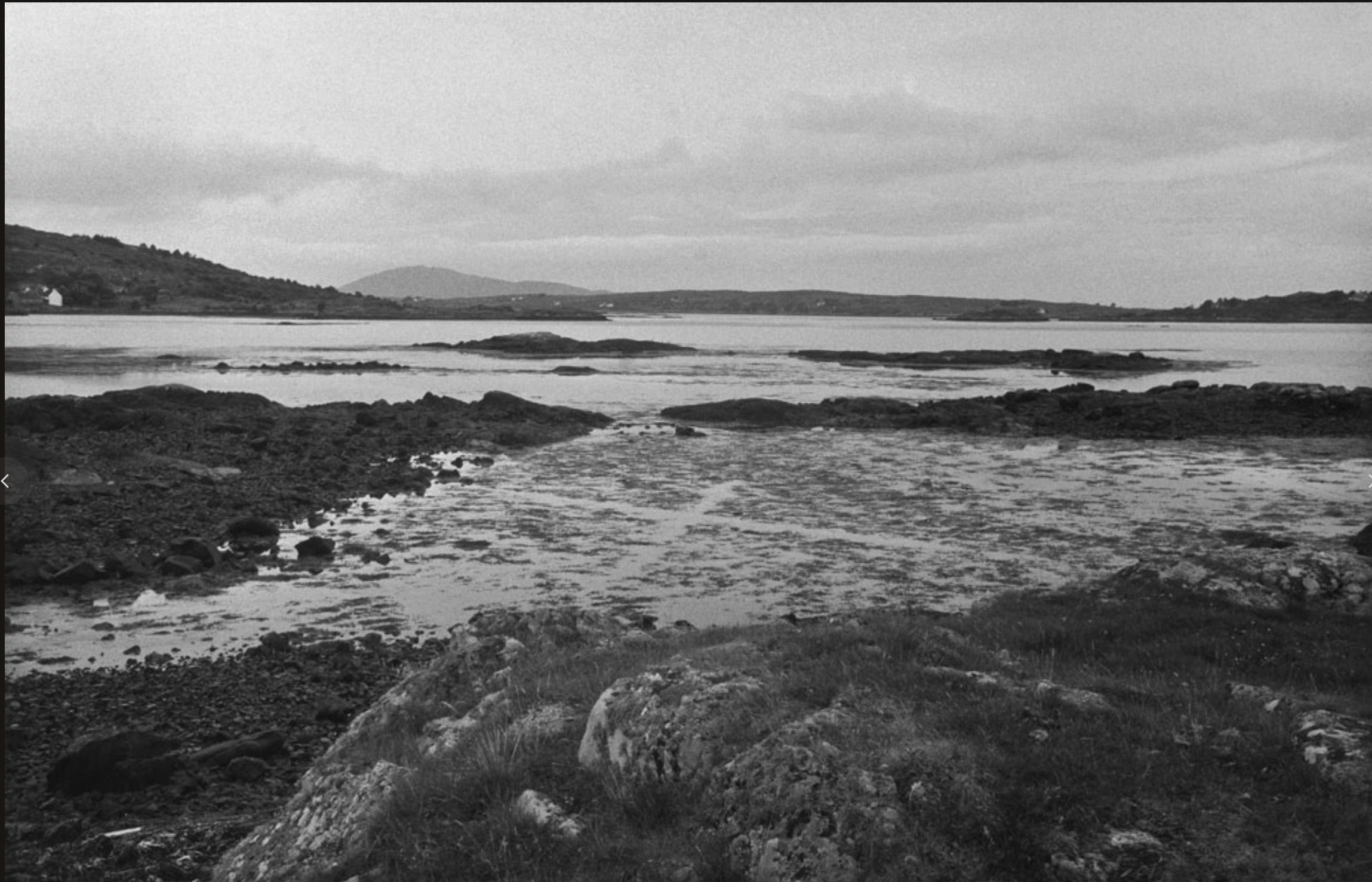
Often the transient is closely related to the eternal.
Some of the most important lost art in Vancouver are the sculptures on the Maplewood mud flats in North Vancouver. People like Tom Burrows and Al Neil lived there and built sculptures and installations in the tidal flats.
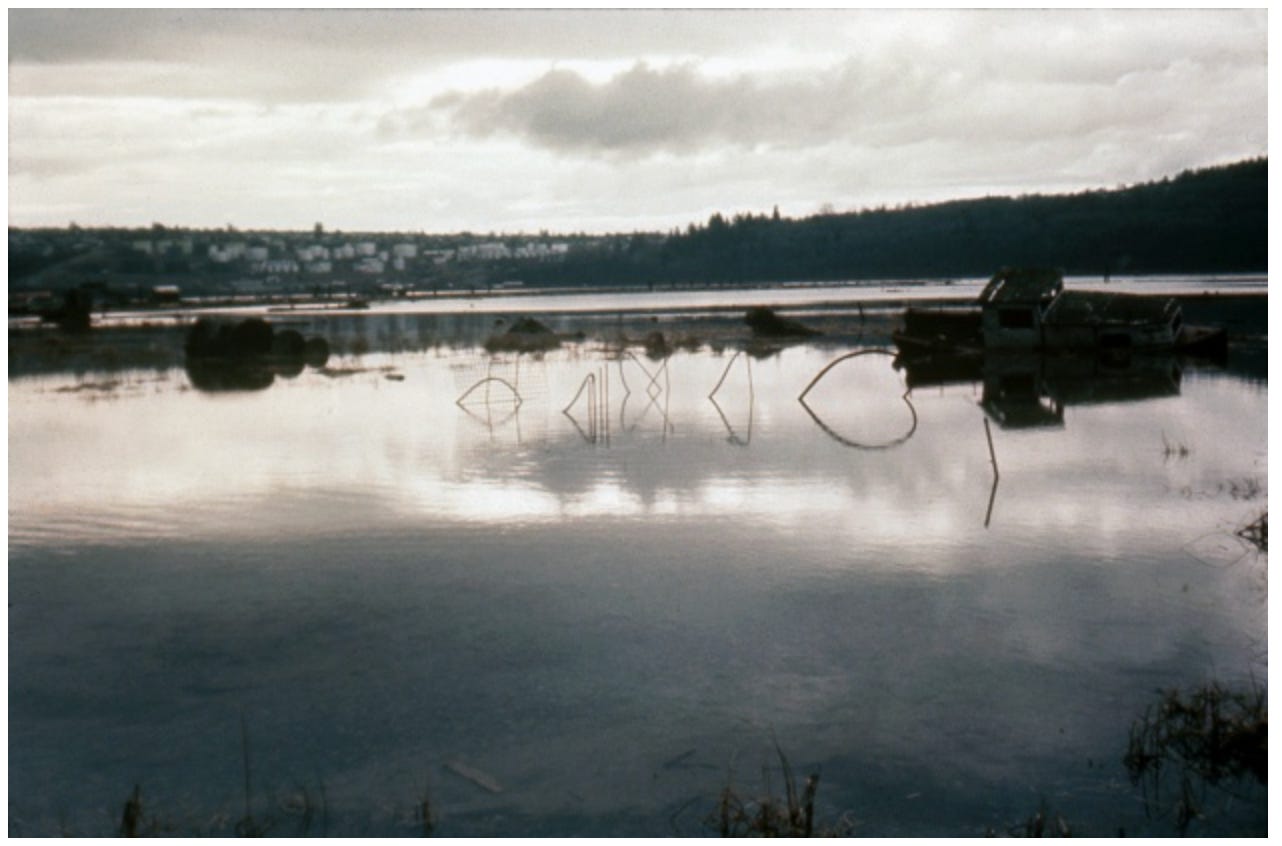
From “Ruins in Process: Vancouver Art in the 60s”
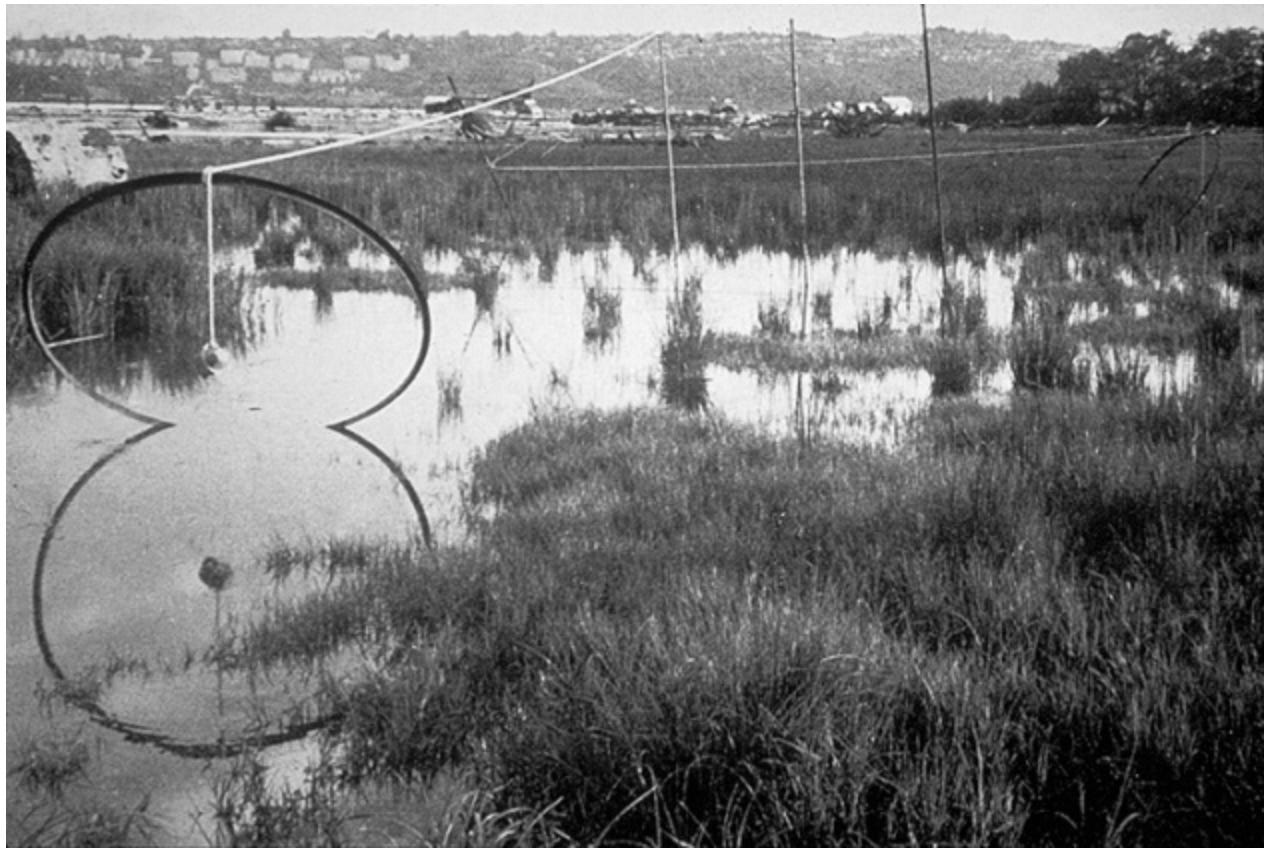
From “Ruins in Process: Vancouver Art in the 60s”
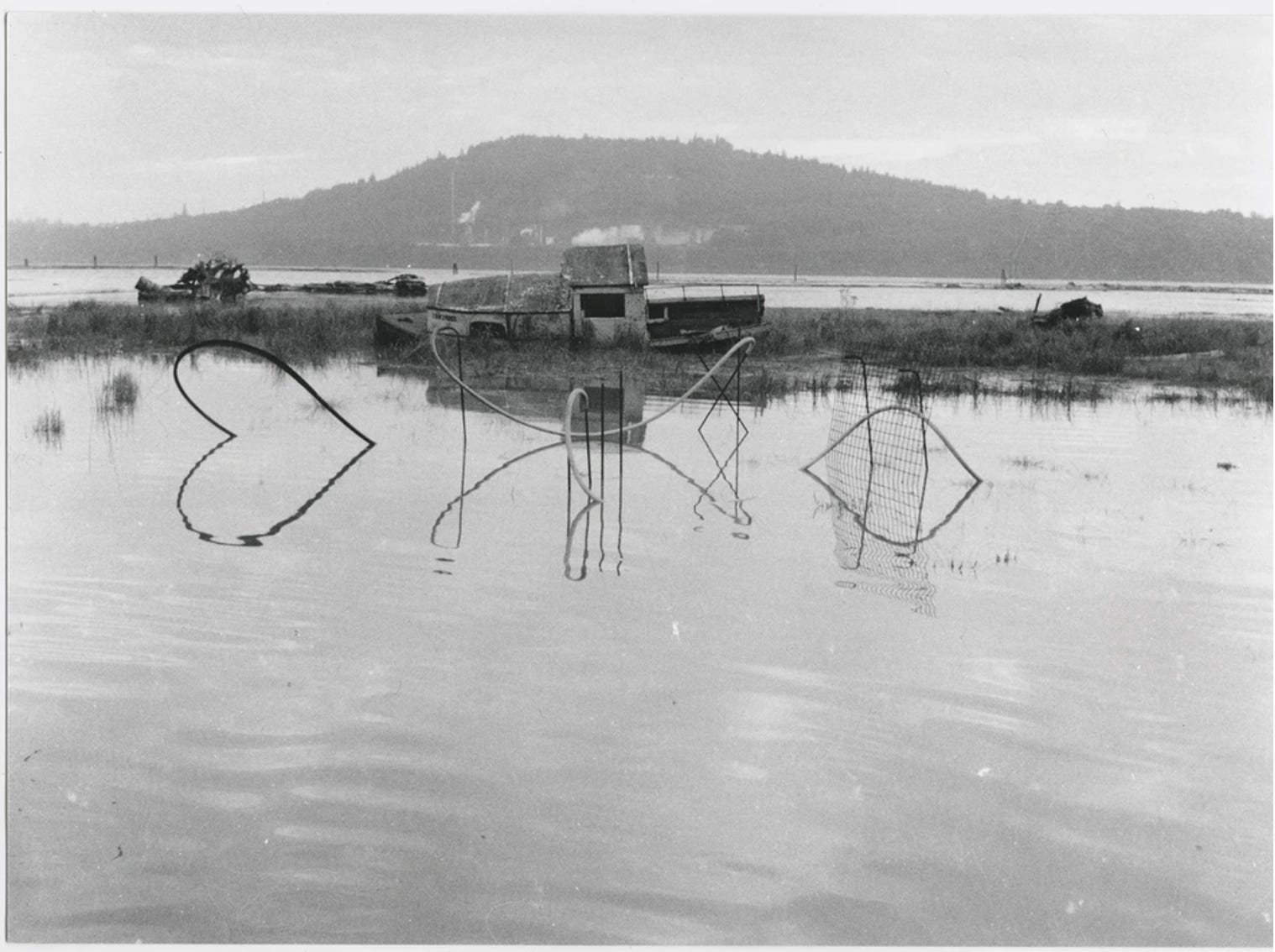
From “Tom Burrows & the mythology of the Maplewood Mudflats squatter community”
There is a bit of a tradition of beach art around the world. Another example is James Hankey in Cornwall.
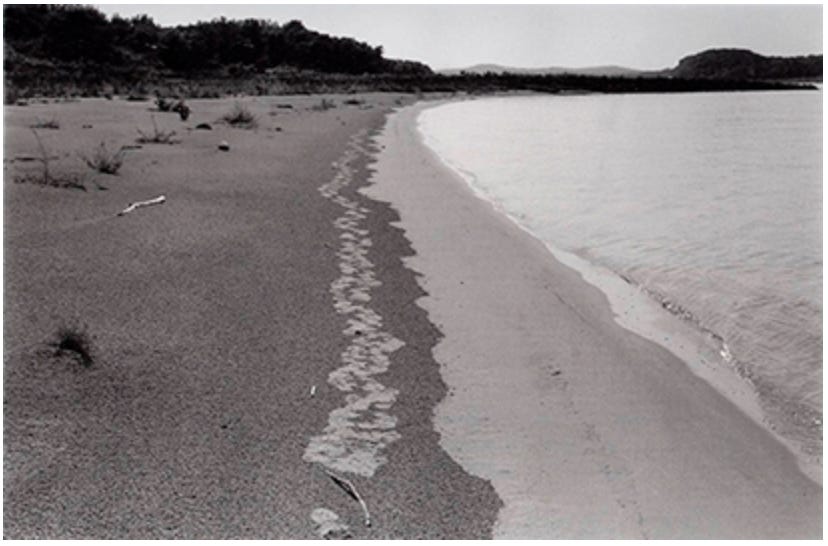
My own community is looser, the people who walk on Secret Beach at the foot of Trafalgar in Kitsilano. This beach is not really secret anymore, but it is a rare natural beach in the middle of a city. Walking it is an important part of my days.
Textures in the Secret Beach Littoral
This littoral has a lot of different micro ecosystems, defined by the physical substrate. Walking from the high tide line to the low tide line one crosses sand, patches of eel grass left by the tide, shell fields, bare stones, stones crusted with barnacles, stones slippery with sea weed, mud, and slime with biofilms.
Sand
Sparse attached algae; occasional sea lettuce drift; sometimes adjacent eelgrass
Sand dollars, sand lance, ghost shrimp, burrowing clams, cockles
Burrowing, hiding, and feeding on suspended particles or organic films
Eel grass
Native eelgrass, sometimes dwarf eelgrass drifted from Japan
Juvenile salmon, Pacific herring, crabs, shrimp, clams, algae and bacterias
Nursery habitat, sediment stabilization, food-web amplification
Shell (mostly oyster):
Attached algae, sea lettuce, microalgae
Juvenile Dungeness crab, oysters, pea crabs, anemones, small fishes, worms
Hard, complex refuge and settlement surface
Stone:
Rockweed, red algae, sea lettuce, kelps lower down (but seldom seen on this beach)
Limpets, periwinkles, chitons, shore crabs, sculpins
Space competition, grazing, attachment, refuge in crevices
Stone with barnacles (good footing):
Barnacle matrix plus patchy algae
Barnacles, dogwinkles, sea stars, crabs, mussels, clingfishes
Filter-feeding matrix that attracts predators and later colonists
Stone with seaweed (slippery):
Rockweed, sea lettuce, red algal turfs, kelp juveniles
Isopods, amphipods, periwinkles, chitons, juvenile fish, crabs
Canopy moderates heat and drying; good refuge, bad human footing
Mud:
Eelgrass patches, green algae, diatoms
Lugworms, bent-nosed clams, butter clams, mud snails, shore crabs, shorebirds
Deposit feeding, siphon feeding, burrowing, bird foraging (crows, seagulls, ducks when the tide is up, sand pipers, surprisingly sometimes sparrows)
Mud slime and Biofilms:
Diatoms, bacteria, microalgae, extracellular polysaccharide film
Western sandpipers, meiofauna, some snails and invertebrate grazers
Microbial primary production directly powers higher trophic levels
Walking the littoral zone requires good footing, slow foot placement, even then I sometimes slip.
High Tide Line
Walking the beach
Listening behind for
Sounds I’ve missed
—
Shore sounds distant
Then near then distant
As the tide shifts
—
The frost line
Along the high tide mark
Waves subside
—
Salt wrack shifting
Flavours from iron to iodine
Biting my tongue
—
Shore sounds distant
Then near then distant
As the tide shifts
Sand
Waves lapping soft
On the sand flat light
Of early morning
—
Beach sand coarse
Grained fine grained
Pulling at his hair
—
Wet sand sticking
To feet and puppy fur
Even the ball
—
Around eleven
January’s full light flooding the lavender
Inside a crab shell
[the lavender: sea lettuce drifted to a hollow]
Eelgrass
Summer coats
The beach with algae
And eelgrass
—
Listening for the smell
Of iodine in the eelgrass
As it starts to rot
—
Sea salt kelp and
Eel grass smell of
Broken oysters
—
Decreated along
The beachwalk a skate
Exposed and decomposing
—
Creek water going
Down under gravel where
It finds the beach
—
Summer coats
The beach with algae
And eelgrass
[linking back: the beach repeats itself]
Shell Field
Low tide rot
Kelp and oyster
Salt smells
—
Crows pushing seagulls
Off the oyster beds raucous
And always hungry
—
Rock stone pebble
Under heavy kelp and sea lettuce
At the end of August
—
A salt stump
Burnished and knobbed
By sand scour
—
Salt mud slip
Scraped by barnacles and
A mussel cut
—
Small steps on
Slippery rocks seeking
Each foothold
—
Crows pushing seagulls
Off the oyster beds raucous
And always hungry
Stone with Barnacles
Small steps on
Slippery rocks seeking
Each foothold
—
Testing the grip
Before committing a step
Moving back
—
The same rock stands
Differently with the sea state
And tide shifts
—
Puppy chest deep
In a wave barks
Knocked down barks
—
Beach rocks organized
By size and texture colour
And shape
—
The rationals being
A dense subset of the reals
As a stone is to water
—
Inside the wave
Stone clutter sound
Subsiding
Stone with Seaweed
Walking on wet
Seaweed trying to step
Straight down
—
Water thin over
Stone sliding onto
And into itself
—
Surface slick and
Glossy slip as dangerous
As wet ice
—
Not knowing how to
Read the water’s surface slides
All over itself
—
Flat calm
Seaweed clinging to
A molten surface
—
One step then
Another pressing
Knee to rock
—
Walking on wet
Seaweed trying to step
Straight down
Mud and Biofilm
Hard sun drying
The mud flats
Everything bright
—
Faint steam off
The puppy pee yellow froth
On dark mud
—
Sea foam crystals and
Air of dead diatoms piling
Up on the beach
—
Crows murder on the mussel flat
Cracking shells scaring seagulls then
Flap off cawing
—
Beach smell dry
Sand burnt rock
Bitumen the kelp
Sea lettuce and wood
Preserved by salt
Rubbing the shore
Iodine as the waves
Break hiss subside
—
Rail silt mud
Rubbing her fingers
Fine as talcum
—
A sparrow drinks
Tilting its head up
Will I have wings
[Western sandpiper at the biofilm edge; sparrow unexpected, present]
Return
Walking the beach
Listening behind for
Sounds I’ve missed
—
Barefoot a little
Beach grit on the floor
From the dog
—
The faces of the people
Grow more beautiful
In the winter rain
—
Again this autumn
I know I am older
Walking the shore
—
A bird in clouds
Drifting across
The empty beach
—
The world of dew
Is the world of dew
And yet
—
Shore sounds distant
Then near then distant
As the tide shifts
—
Tide floods into its form.
Tide ebbs from its form.
Some sources
Boaden, P.J. and R. Seed (1988). An Introduction to Coastal Ecology. Springer
Kozloff, Eugene N. (1983). Seashore Life of the Northern Pacific Coast: An Illustrated Guide to Northern California, Oregon, Washington, and British Columbia. University of Washington Press.
Long, Richard (1998). Mirage. Phaidon.
Neil, Al (1989). Changes. Nightwood Editions
Odum, Howard T. (1994). Ecological and General Systems: An Introduction to Systems Ecology. University. Press of Colorado.
Watson, Scott and Ian Wallace (2018). Tom Burrows. Figure1.
There are also references to haiku by Basho and Issa.
この秋は何で年よる雲に鳥 芭蕉
Again this autumn
What am I older
A bird into clouds
(Note: I have an intentional mis translation here as I remember この秋は as この秋も
露の世は露の世ながらさりながら 一茶
The word of dew
Is the world of dew
And yet