
Reflection and Perspective in Quiet Noise
Version 2 - Revised April 2026

Rain quiet decay
In reflection on
Our presence
Pixelation deep inside
The reproduction rippling
Across the grid
Kinetic potential
A path of minimum action
Traced across the field
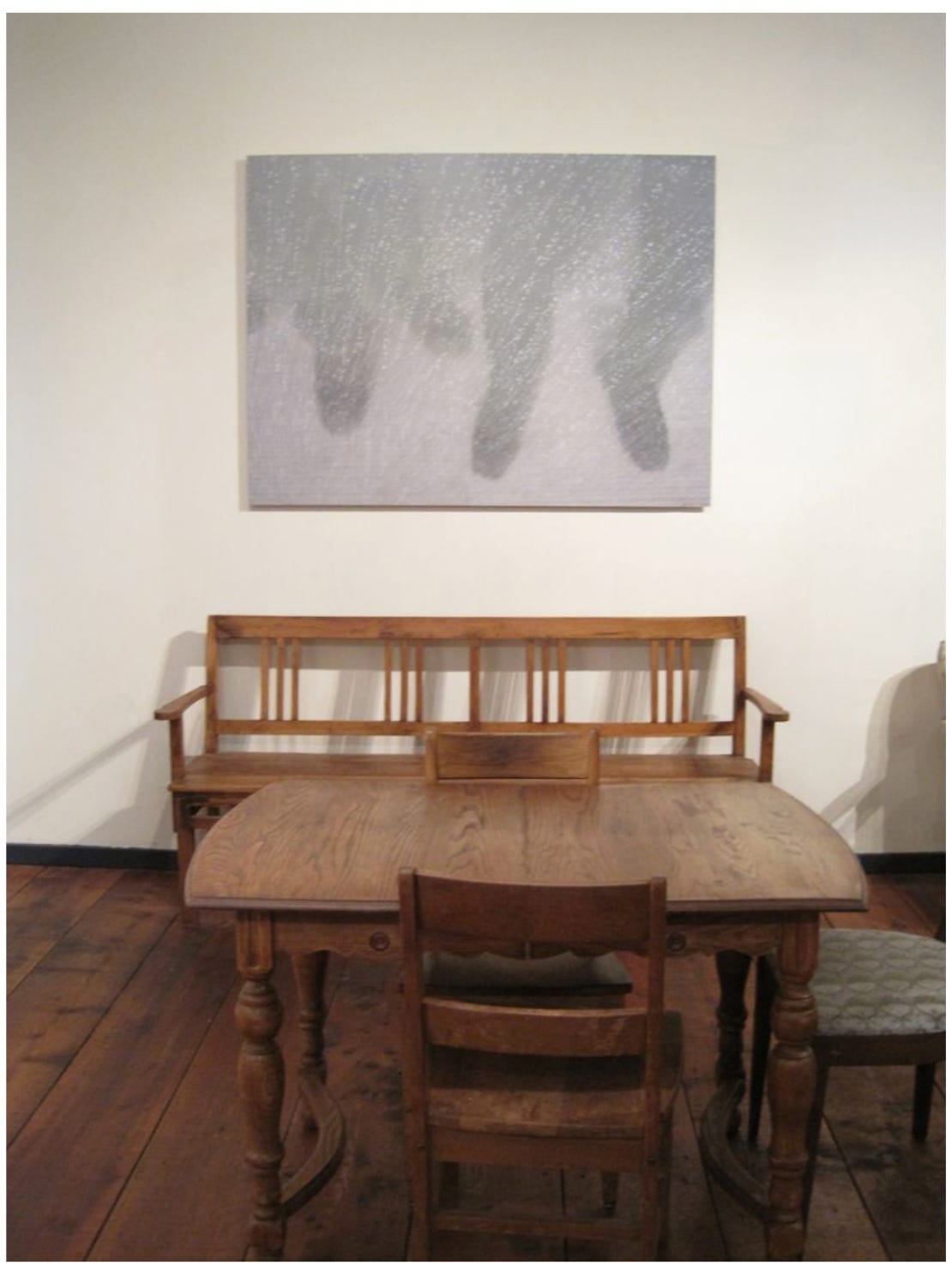
The central image in Yoshie Hattori’s Quiet Noise show is one of those odd images that the gaze slides over then stops, perplexed, but not sure why. The photo is grey and quiet. It is the photo that inspired the name for the whole show – Quiet Noise. I have known this photo for several years as Yoshie used it in a post back in March 2009. I was present at the Institute of Contemporary Arts in Boston when it was taken. (You can actually see my feet in the top left.)
Seeing this image at scale changes the experience. The reproduction used in the show is about 150 cm wide by 114 cm tall (60” x 45”) and is a bit larger than real life. The original was taken with a cheap point-and-shoot that Yoshie happened to have with her that day. Looking closely, one can see some noise in the large image, although Alan Sommerville at Fidelis Art Prints did his usual superb job printing this out. The noise in the image is part of how it works. Listening to rain, something we get lots of opportunities to do in Vancouver, is listening to a very fine form of noise. There are complex relations between the digital artifacts in the image, the rain drops on the glass and the fine grid of the floor.
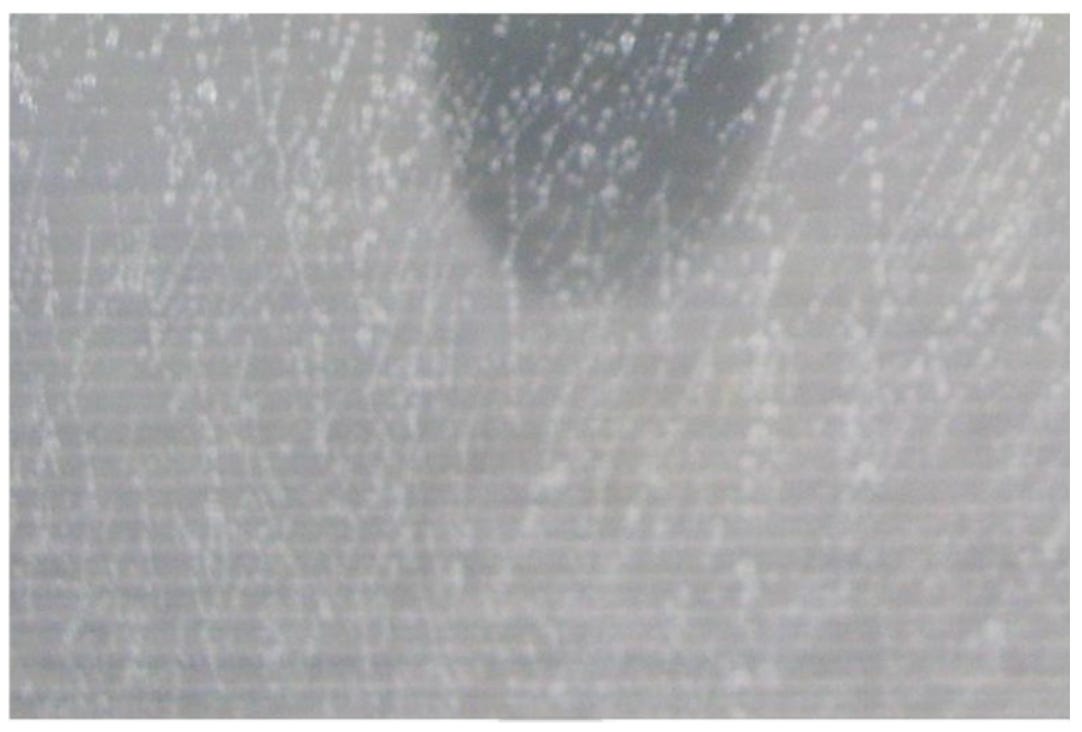
The raindrops are in clean focus in the upper part of the photo. They are present and hold their surface tension. The dispersion is open enough to give each drop its own figure-to-ground coherence. Moving down and to the left the drops slip out of focus and begin to streak then blur, giving a quiet image its own movement. Towards the bottom the drops become more of a film layered onto the grid of the floor. When I was looking at this image online I did not pay much attention to the grid, but it is there at the edge of perception, and, at a larger scale, stabilizes the image.
Surface tension – through movement – to blurring – and a grid on which people stand. The grid quietly organizing the noise.
A fine grid laid
From the floor onto the glass
Under the raindrops
Potential energy expended
By the rain on the glass and
Its slow glide
Surface tension beads
Water on the glass surface
As a pause in time
Small, on a phone or laptop, is how I see most images these days. Having this reproduction in front of me, slightly larger than life, changed the way I enter into it. At first this is disconcerting. On which side of the surface are these people standing? Are they out in the rain, beyond the glass surface, in the luminescence of the open air? That is my first impression. But a closer look, with attention to the grid and reflections, reveals that these people, and I am one of them, represented most clearly by their shoes, are actually standing on the same side of the image as the viewer and we are looking at their reflection in the glass. The rain has beaded on the far side of the glass. Disconcerting. Even more disconcerting is that the photographer is one of the people in the photo, at least her shoes are. This is unusual in Yoshie’s photos, she is usually absent. Here she has photographed a reflection of herself, with her husband and youngest son.
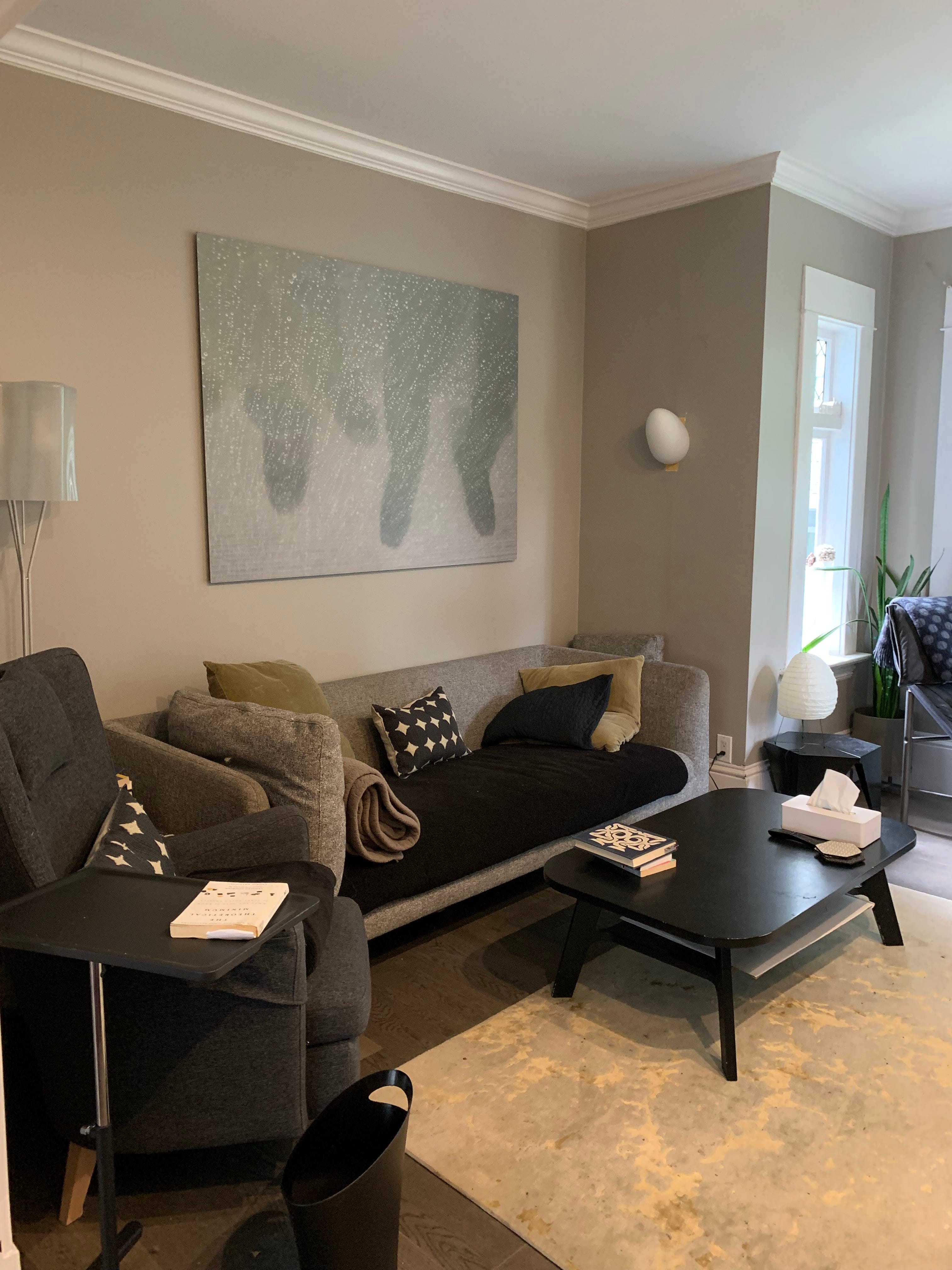
I have lived with this image for about 15 years now, first in small format, then in the gallery setting, and for the past 12 years it has hung in the living room. The art you live with is experienced differently from art you see intentionally in a gallery on on a device. Before anything else it is just there. It changes as the light changes across the day and the seasons. The art ages, sometimes imperceptibly, sometimes rapidly. One looks at it, talks about it, in different moods, with different people.
Over the years Quiet Noise has become more grey to me, I notice the many different greys more and the gradations between them. Most of the pixelation is at the finest transitions between the greys and grays. Depending on the time of day and cloud colour some of the greys shade into a gray-green. A sort of scum in the light.
Time has let me pay more attention to the grid. It is in focus in the bottom fifth of the photo and blurs out about a third of the way up. Blurs out but is extended under the surface of perception. The grid continues to organize visual presence even after it has been washed out by the light.
There are three people present in this picture. As noted above the reflection makes it seem like they are standing on the other side of the glass, out in the rain. The three people are the one taking the picture, my wife artist Yoshie Hattori 服部芳枝 - foreground on the right, our youngest son 服部研次 - mid ground in the centre, and myself at the back on the left. Our life circumstances have changed a lot since this picture was taken and between the exhibition in 2013 and today. Kenji was living in Montreal at the time attending McGill. He now lives in Los Angeles and works as an architect. Yoshie and I were living in the South End of Boston at the time and are now back in Vancouver. Yoshie and I have had some severe illness to deal with. We remain focused on family and our work. This image has been in the background of the past decade.
The raindrop’s path
Of least action from
Cloud to glass
Glass covered not
With dust but rain static
Presence lost
The triangle of
Glass rain reflection
Speaking with each other
Ideas circulating in the background as I revised these comments and wrote the nine notes.
Lagrangian mechanics is a reformulation of classical mechanics introduced by Joseph-Louis Lagrange (1788) that defines a system using its kinetic (T) and potential (U) energies rather than vector forces. It focuses on finding the path that minimizes the “action” (the integral of the Lagrangian L = T - U) using the Euler-Lagrange equations, offering a simpler approach to constrained systems. From Wikipedia.
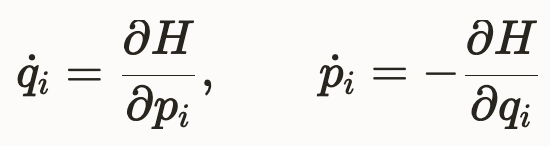
Hamiltonian mechanics is a formulation of classical mechanics that describes a system’s time evolution through its total energy (Hamiltonian) in phase space, using coordinates (q) and momenta (p) rather than positions and velocities. It reduces second-order Newtonian equations into two first-order Hamiltonian equations, emphasizing geometric structures. See Wikipedia.
Three books to read while thinking about Quiet Noise.
Deleuze, Gilles translated by Paul Patton (1968, translation 1995) Difference and Repetition. Columbia University Press.
Higgins, Hannah (2009), The Grid Book. MIT Press.
Suuskind, Leonard and George Hrabovsky (2013). The Theoretical Minimum: What You Need to Know to Start Doing Physics. Basic Books.
Originally published November 2013 as part of the Quit Noise exhibition.
This version substantially edited April 2026.
Thank you to Coco et Olive, Joanne Facchin, Hanif Jan Mohamed and Barbara Cohen for their help in organizing this exhibition. November and December 2013 at Coco et Olive (Main and 21st, Vancouver, BC).
I love this piece and your updated reflections. For me bleak, bleary and blurry evolves to cloudy then calm and finally clarity. All is well, everything is as it should be - keep calm and carry on. Very apropos in today’s topsy turvy world.