
Wave collapse
When a wave falls over itself

What is the relationship between a note and an equation or function?
An equation could be expressed as a note.
A note can unfold an equation.
A note can connect equations or connect functions.
If then … else
There is a thread through my notes around equations. Some of these are attempts to comment on the equation or function in ways that make sense to me. Other times I want to call out the emotional resonance. And sometimes I want the note to block understanding so that my thoughts (and I hope my readers thoughts) can go off in different directions. Some notes combine all three valences.
Recently I have been mostly using a three line form.
xxxxx xxxxxxx = yyyyy or xxxxx = yyyyyyy yyyyy sometimes xxxxx = yyyyyyy = zzzzz
I have also used square forms (parallelograms really) do do this.
wwwwwww = xxxxxxx
yyyyyyy = zzzzzzz
xxxxxxx = yyyyyyy
yyyyyyy = zzzzzzz
and so on.
Wave functions
I am obsessed with waves and wave functions. The four dimensional movement of a sailboat in waves: pitch (up and down), yaw (left and right), surge (forwards and backwards) and how these combine in time over the cycle of a wave.
I spend a lot of time just watching waves: how one wave can surge over another on open water; how and where they break across a shoal or on the beach; how they suck back away from the land.
When I was recovering from cancer surgery I was fortunate enough to spend some time swimming in the surf off a beach on Kauaʻi (back when it was still possible to travel to the US). I spent hours swimming up and down the beach, looking for back currents, slipping in and out of the surf.
Swimming in surf
Wave torqued driven
Under held under
In the sand bubbling
Surfacing into
Spume salt air
Swimming in line with
The waves swimming
Under the current
Swimming over
A reef break line
The current dragging west
Finding the small back eddies
The lines inside lines
That slip back east
Over the reef line
Surfacing submerging
Half surfing a wave
Back towards the beach
Knocked down and twisted
Emerging new onto the beach
Notes
We stayed right on Kiahuna Beach. The sand was a complex gold, soft but rough crystalled, beautiful to walk on. Stepping onto the sand I sank into my ankles. Where the last run of the surf reached my feet were quickly sucked under and it was hard to stand.
There was about an 8 foot break out on the reef and 3 to 4 feet of surf on the beach. I was a bit hesitant at first, but swam in the waves every day, diving under the breaking waves, swimming out to just inside the reef and generally bobbing around. A few times I would let a wave take and tumble me onshore. I tried to body surf but never got it quite right and had rides of only a few seconds. By the end of the trip I was swimming from one end of the beach to the other and back.
There was a current running to the west and the first day I was not able to swim back against it and had to get out at the west end of the beach and walk back in the caressing sand. Over time I learned to pay more attention to the many subcurrents running and to find back eddies to swim in when I wanted to go back. Moving a meter towards or away from shore could change the current.
The waves brought life back into my body. The sea foam in the air was good for my lungs. After an hour of swimming in the waves my body was able to rest and my mind flow easily.
(From The Black Notebook and Other Work, 2022)
Some equations
Here are some equations I often think about.
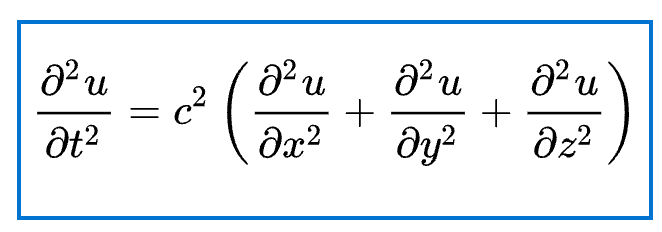
(Note: Need to relearn Latex so that I can enter equations properly.)
where
c is a fixed non-negative real coefficient representing the propagation speed of the wave
u is a scalar field representing the displacement or, more generally, the conserved quantity (e.g. pressure or density)
x,y, and z are the three spatial coordinates and t being the time coordinate.
Note that waves are defined in three dimensions plus time. Note that ‘c’ here is not the speed of light but that it is the speed of the wave.

Simply, a Fourier transform takes a complex wave and breaks it down to show the frequencies that make up the wave.
I first started to use Fourier transforms back when I was studying in the Sleep Lab at Carleton University. Alan Moffitt taught me a great deal about thinking slowly about problems. We would take the ECG waves we recorded and apply the Fourier transform to understand the different components of the brain waves and how these change over the course of a night.
One of the most intense experiences I have had of sound waves was in La Monte Young and Marian Zazeela’s Dream House in Tribeca.

The sound is generated by 32 sine waves. It is a just intonation tuning system based on the harmonic series between frequencies 288 and 224 Hz. This creates a symmetrical structure around a center frequency of 254 Hz, which equals the prime number 127 multiplied by 2. The interval 288/256 reduces to 9/8, as does the interval 252/224. Of the 32 frequencies that satisfy Young's criteria, 17 fall within the upper range of symmetrical 9/8 intervals, 14 fall within the lower range, and one sits at the center. Young has arranged these 31 frequencies symmetrically above and below the 32nd frequency—the center harmonic 254.
Sit as still as you can and let the sound fill you. Then slowly move your head in each of the three axes (left right; up down; front back). The sound you hear changes. Let your body sway in circles and follow the sound waves around. Once you are centered in the sound you can move around the room creating paths through the different frequencies and their harmonies.
How waves break on sloping beaches.

where ξ is the Iribarren number, α is the angle of the seaward slope of a structure, H is the wave height, L0 is the deep-water wavelength, T is the period and g is the gravitational acceleration. Depending on the application, different definitions of H and T are used, for example: for periodic waves the wave height H0 at deep water or the breaking wave height Hb at the edge of the surf zone. Or, for random waves, the significant wave height Hs at a certain location.
Waves can break in different ways.
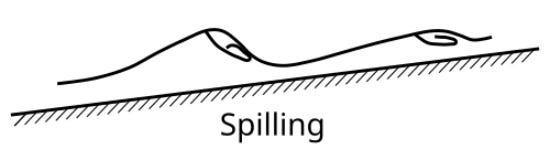
Spilling breakers
The wave steepens
Unstable whitewater
Spilling down the face
—
Water sliding over
And under itself slipping
Air into foam
—
Spilling breakers occur when the ocean floor has a gradual slope, the wave will steepen until the crest becomes unstable, resulting in turbulent whitewater spilling down the face of the wave. This continues as the wave approaches the shore, and the wave's energy is slowly dissipated in the whitewater. Because of this, spilling waves break for a longer time than other waves, and create a relatively gentle wave.
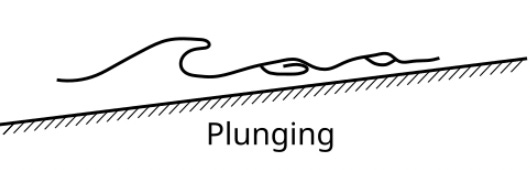
Plunging Breakers
Shoaling the wave
Goes vertical then curls
Over itself
—
Instant release
Of energy into foam
And turbulence
—
The crash shakes
Sand grains on the beach
Under our feet
—
A plunging wave occurs when the ocean floor is steep or has sudden depth changes, such as from a reef or sandbar. The crest of the wave becomes much steeper than a spilling wave, becomes vertical, then curls over and drops onto the trough of the wave, releasing most of its energy at once in a relatively violent impact. A plunging wave breaks with more energy than a significantly larger spilling wave. The wave can trap and compress the air under the lip, which creates the "crashing" sound associated with waves. With large waves, this crash can be felt by beachgoers on land.
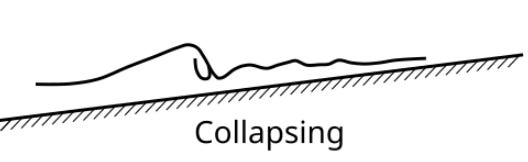
Collapsing Breakers
Collapsing underneath
The crest remains intact
Subside in foam
—
Collapsing waves are a cross between plunging and surging, in which the crest never fully breaks, yet the bottom face of the wave gets steeper and collapses, resulting in foam.
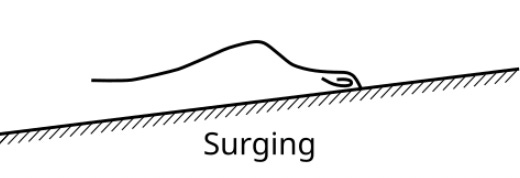
Surging Breakers
Long period low amplitude
Waves against a steep shore
Rise up and subside
—
Surging breakers originate from long period, low steepness waves and/or steep beach profiles. The outcome is the rapid movement of the base of the wave up the swash slope and the disappearance of the wave crest. The front face and crest of the wave remain relatively smooth with little foam or bubbles, resulting in a very narrow surf zone, or no breaking waves at all. The short, sharp burst of wave energy means that the swash/backwash cycle completes before the arrival of the next wave, leading to a low value of Kemp's phase difference (< 0.5). Surging waves are typical of reflective beach states. On steeper beaches, the energy of the wave can be reflected by the bottom back into the ocean, causing standing waves.
Anything exists only when a wave has collapsed. A note is a sort of wave collapse where attention and potential are reduced to a few words. But then the note opens its own set of potentials that collapse again each time someone reads or recites it.
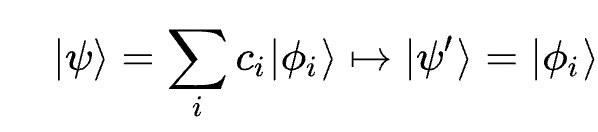
The arrow here represents the measurement of the observable (writing the note, then someone reading it, even the author). Ci is the complex coefficients of the state. φi is the eigen state (the possible values of what can be observed expressed as a vector).
Ci = φi | ψ the overlap of the eigen state and the quantum state. This is the collapse.
Writing takes place within a very large field of connected potentials. Writing is to collapse that field to create a new field of potentials that another person can explore.
Note: Eigen vectors (or Eigen states) show up a lot, in quantum physics but also in machine learning. They are non-zero vectors that, when a linear transformation (like a matrix multiplication) is applied, only get scaled (stretched or shrunk) but don't change their direction (or they reverse direction). The factor by which they are scaled is called the eigenvalue, a scalar representing the "how much" of the stretch or squish. Essentially, eigenvectors define the axes or fundamental directions along which a transformation acts purely by scaling. In machine learning they are used in principle component analysis, feature extraction and clustering. All of these are central to understanding how a system of notes works, and to writing the notes. A note can be represented as an Eigen vector in a semantic space (a space of meaning). The notes together form a network. One of the intents in Folding Notes is to discover these networks.
I always enjoy the mathematical connections you make with poetry and the natural world. At first I thought you meant a musical note, but then toward the end you mention the written notes. I also enjoyed the breakdown of the different types of waves and how that's effected by how steep the shoreline is.