
March - Raw Notes
From Tokyo back to Vancouver

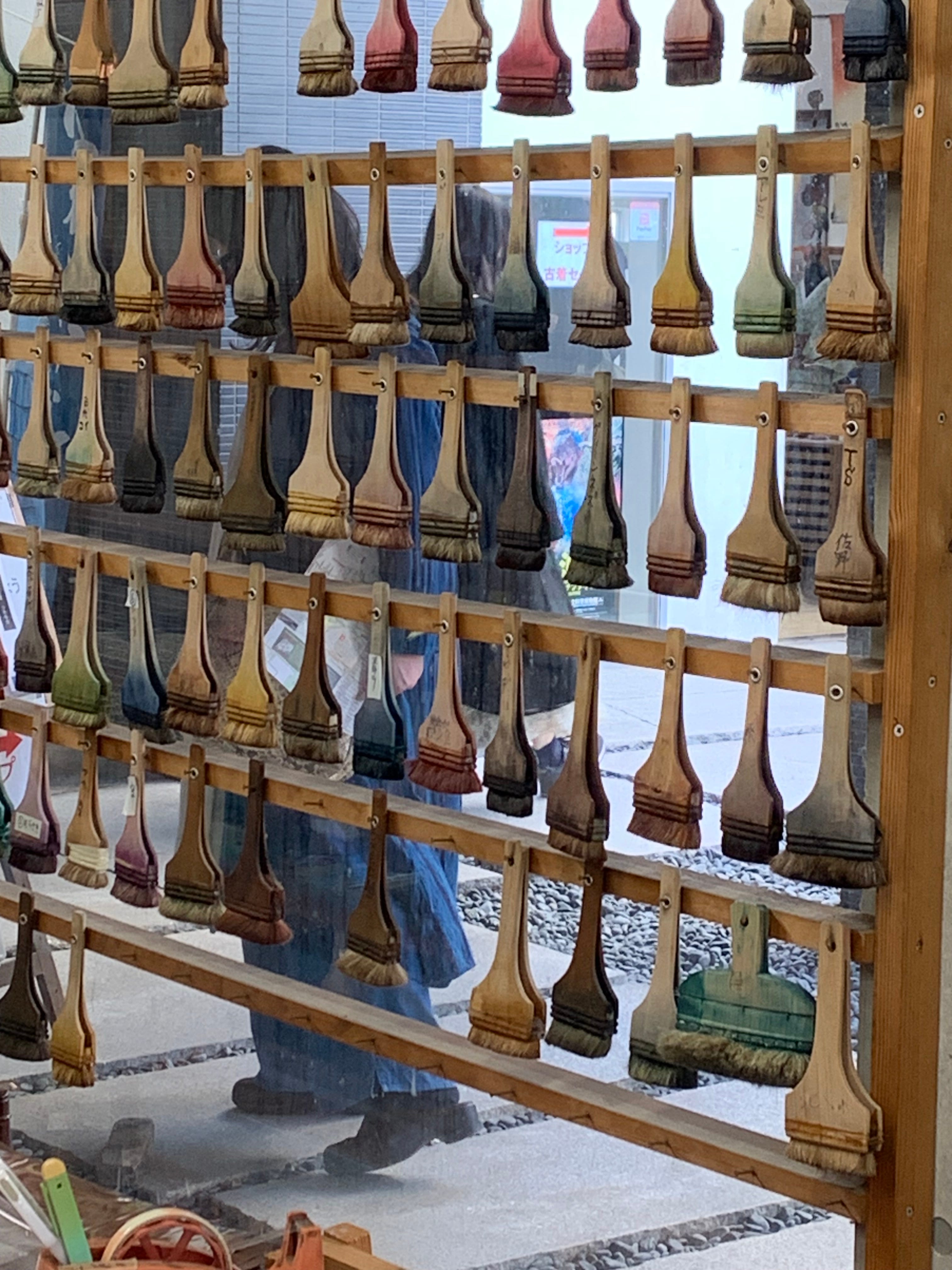
This is a bit of an experiment. These are my raw notes from March with minimum editing. Some editing or rewriting has happened as the notes are often hand written first, on scraps of paper, in the back of books I am reading, in emails or other places. When transcribing them I often rewrite.
These notes are not finished. They are likely to be revised and then recomposed into threads drawing on notes made over several years.
I am not sure if I will continue to share raw notes, we will see what people say. There is some dreck here.
The notes are shaped by a few things. My ongoing obsessions (objects and things, how math is embodied in the world, origination, phase transitions-transformations- connections, patterns); my reading; where I am in the world; conversations; health.
I started March in Tokyo where I was staying in the family house where Yoshie was helping to care for her sister. Our oldest son was also in Tokyo and I visited the book district Jinbocho 神保町, Kamakura 鎌倉 and meandered around shitamachi 下町 together. For the first time in many years I spent time catching up with old friends, several of who I had not seen this century!
I was sick most of the month with a chest cough, recovering only towards the end. There was a lot of rain in Vancouver (an atmospheric river) but the weather did improve, the trees and bushes blossomed, and we spent time in the garden.
So here is what I noticed, or at least the parts of what I noticed that I could put into words.
Say a word and
Another picks it up
To pass on
—
Ueno
Old man on a bench
In the sun studying
Go problems
—
Each morning
Trying to call her house
From sixty years ago
—
Who are you and
Where have you been I
Need you and forget you
—
Grey rain present
Softening the morning
Cold
—
Unsure what to do
I wash the dishes
Listen to them fight
—
A dry point becomes
An irritant in the throat
Coughing coughing
—
As simple as a
Glass of water and
A dry throat
—
The world is all that
Is other than the water
Rippling into light
—
March night still
Cold deep in the air
Faint warmth
—
Spring snow
Swallowing air
White as water
—
White as water
Is opaque
To my intent
—
Swallowing air
Into cold lungs
The snow melts
—
Enough snow for
A one year old to eat
Along with some mud
—
Asleep leaning
On one arm with
A book as a rest
—
Awake at the centre
Of a white triangle
Collapsing
—
Sampling enough of
The distribution to lose any
Pretence of certainty
—
As the rain became
Sleet then back to rain
In the interval
—
Leaving the scalding
Water the skin dries quickly
Tender to the light
—
Light sensitive air
Rippling through wave collapse
In the glass
—-
At the end of a cold
Eating oranges and
A blue sky
—
Comparable luck
By chance told of
Other measures
—
Trying to breath
Shallow and not cough
The air thin
—
Gurgling sounds
From phlegm
Clogging the lungs
—
Colours flare
At the edge of the mirror
Into black
—
Glass flow holding
Eighty years of
Captured light
—
Trying hard to
Live normally ending
Exhausted
—
Sinus pressures
Shifting as the
Air dries
—
Spring’s first chives
Dark green and almost
Black near the roots
—
For Christopher Hitchens (after reading Mortality)
No person is whole.
That is what freedom
We are allowed.
—
Puppy crunching
Dry sardine heads
Looking happy
—
The weight of
The dog’s head on my feet
As we dream
—
For Wittgenstein
Boiling water
Turns to vapour absorbed in
The vanishing light
—
Scalding water
To ease her swollen ankles
The air thick
—
Trying to measure
The distance between raindrops
As they fall
—
Uncertainty the
Range of probability and
Chance it will rain
—
A few lights left on
After midnight to find
Paths in the dark
—
The order of
The rooms at 2:00 AM
With all lights off
—
Her mind failing
She can still describe
Her exact pain
—
Pain has a precise
Location in space and time
But remains a probability
—
Scratching to trigger
Inflammation to fight
The growing bacteria
—
A narrow world
Forcing contraction
Into some reality
—
Luminous blacks
Remembered from inside
The mountain cloud
—
Luminous black
The inside of the outside
Of the tea bowl
—
Kettle boiled dry
Many times leaves a patina
On the base metal
—
The same water
Under different clouds
The same water
—
Step outside and wait
For night vision
Several stars
—
Not rain but
Water in the air
Inhaling droplets
—
Dropping things more often
My hands stutter like
Words hard to speak
Some reading from March …
I continued to read John Clare Major Works. I am only on page 142 of 487 pages. I keep dipping in and out of this while reading other poetry.
Floating Words by Yoko Danno, especially her translation of the renga sequence Minase Sangin Hyukuin 水無瀬三吟百韻 published by Isobar. I read Minase Sangin Hyukuin several times, in several different ways - straight through, focusing on links, writing it out on a traditional set of folded sheets of paper. This is I think the finest translation available of this key renga sequence.
Paul Klee's Table and Other Books by Yoshioka Minoru 吉岡 実 translated by Eric Selland, also from Isobar. Eric also translated Kusudama 薬玉, which I published many years ago and Isobar has republished. Language is alive in these translations.
One more from Isobar was Kotan Chronicles by Sarashina Genzo 更科源蔵 translated by Nadine Willems. These poems, from Hokkaido, are sending me to reread Miyazawa Kenji 宮沢 賢治 and Donald Philipi’s Ainu translations Songs of Gods, Songs of Humans.
In March I also completed one of my reading strands for this year with A Treatise on Stars by Mei-Mei Berssenbrugge. I read pretty much every one of her books I could get my hands on in the first quarter, this one and Empathy moved me the most.
In March I tried my hand at a poem in the style of Zukofsky’s 80 Flowers (see Freesias for Jocelyn). This has led me to Michelle Leggott’s Reading Zukofsky’s 80 Flowers. I am still early in this reading.
I did read two novels in March.
Under the Eye of Big Bird by Kawakami Hiromi 川上 弘美 translated by Asa Yoneda is a wonderfully imaginative and disrturbing novel of the deep future, the end of the human race, and our AIs. Here is an interesting interview with author and translator.
Archipelago of the Sun by Towada Yoko 多和田葉子 translated by Margaret Mitsutani. This is the third in the series Scattered All Over the Earth and Suggested in the Stars.
Not all my reading was literature.
The End(s) of Knowledge by University of Toronto mathematician Micahel Yampolsky explores hard mathematical limits to what we can know or predict. These are limits that are part of mathematics, like Fermat’s last theorem. He explores limits to prediction in the context chaos theory and Lorenz attractors.
Mortality Chrisotpher Hitchens. Hitchens died of the same cancer I have and the onset of his symptoms was eerily similar to my own. I was very lucky in that I could get surgery before the cancer spread to my lymph system. Hitchens was not so lucky. The change in the style and form of writing in the final chapter is harrowing. The following, including the use of punctuation (currently rare for me) was a direct response.
No person is whole.
That is what freedom
We are allowed.
The Meaning of Property by Jeddiah Purdy. It took me a while to get into the style of discourse and reasoning in this book and its engagement with legal history and precedent. Eventually my brain adapted. What we mean by property has changed over time and is changing again now. I expect to think a lot about this over the next few years and this book is part of getting grounded. There is a lot about property and freedom in this book and understanding freedom on three levels: negative liberty (nothing interferes with my choices); positive liberty (I have meaningful choices to make); psychological liberty (the capacity to perceive, pursue and revise what my own interests are). This is sending me back to Amartya Sen’s book Rationality and Freedom, which I will need to dig out of the stacks.
Being an intensive notebook writer (a journalist, in yet another sense of the word), I am of course hugely in favor of reproducing the notes more or less as is. I enjoy reading notebooks of major writers and thinkers from Wittgenstein to Kafka (was just dipping into The Blue Octavo Notebooks as I do from time to time and took down many quotes). I rarely reproduce my notes outside the notebooks. This would certainly be a step towards producing a work in the conventional sense, but I have not had a strong enough desire to do so. I did keep a journal in electronic form during a short period in which I was between notebooks. I did not yet have a new notebook on-hand and wanted to use the one that I had left behind in the Machida house. I found that typing into the electronic file generated lines of thought and types of narrative and descriptive writing that normally do not appear in the notebook. It has a value in and of itself, but it's not the notebook as I understand it - written in hand in a physical notebook, influenced by the type of pen and type of paper one is using. The physical notebook often determines the type of writing (see Ron Silliman's Chinese Notebook). So these are really separate activities. In any case, enjoying reading your notes in the form of haiku as always. I especially liked that last one inspired by Christopher Hitchens and wrote it down in my notebook. And now it's time for another piece of calligraphy (another thing that makes the physical notebook essential.)