
Writing as hyperobject - reprise
What I learned

This spring I started a series of five sequences on writing as hyperobject. I took each of Timothy Morton’s five attributes of a hyperobject from his book of the same name and built a sequence around each attribue (a sequence is a collection of threads composed of notes, more on this below).
The five posts are
All this started back in March with Flat Ontologies, my entry point into connecting my own work with object oriented ontology.
So what did I learn from all this?
I got a better understanding of my own obsessions and how they connect in sometimes strange ways. One line I obsess on is
Gone given lost
And variations on this
Gone given other
Gone given into
Gone given else
To my surprise, versions of these show up across many of the sequences. These lines resonate deeply with me, they capture something of my distancing from myself, especially when I was fighting cancer. They also echo back to a line from Material Space that is always with me.
Aloe a purgative allow
I am not sure why some lines stick with me, but they also seem to get picked up across sequences … there is more to this than I understand.
Notes on method
My method for organzing notes into sequences evolved quickly while I was working on the Hypeobject series.
To understand this a bit better, here is how the method for building these sequences works at this point.
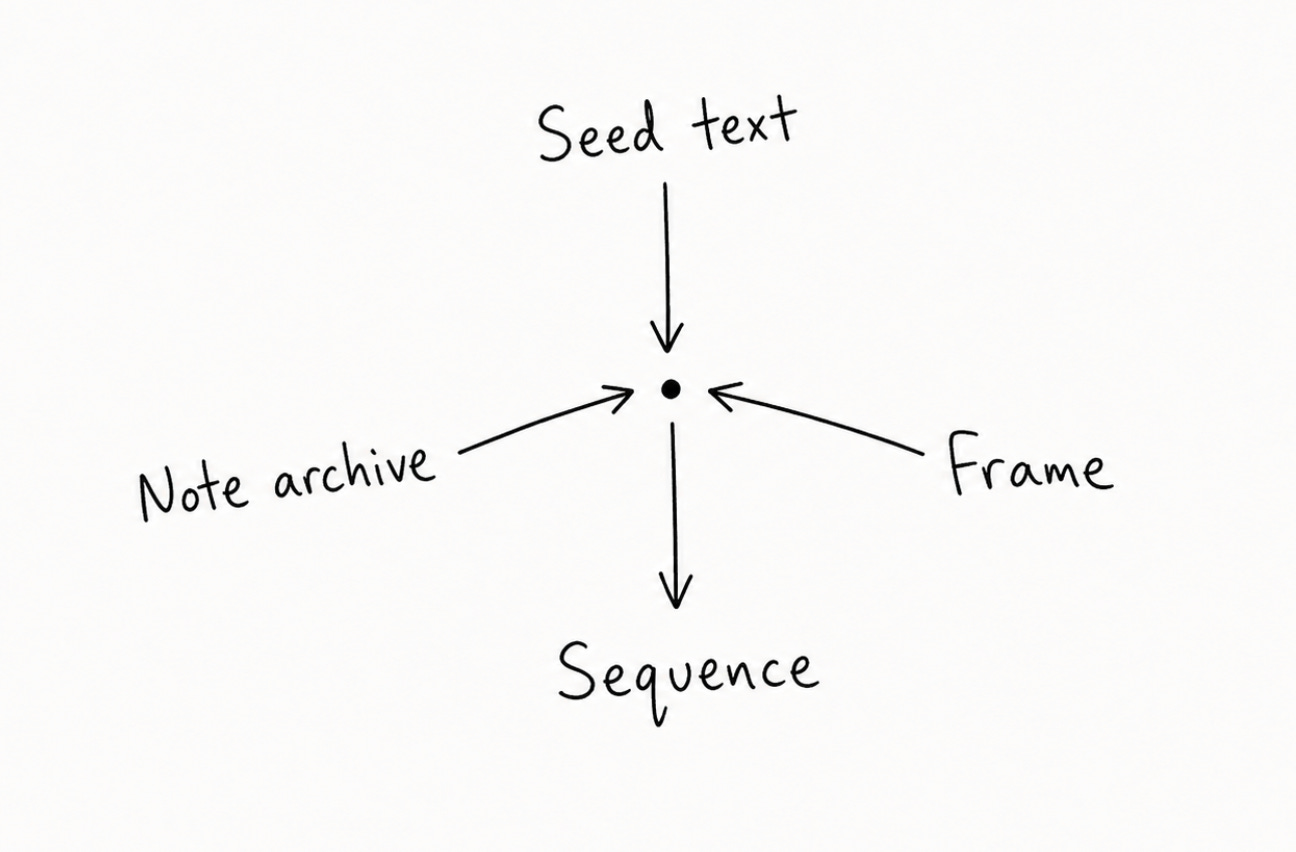
This came into better focus as I worked. At a high level, what I have been doing is to develop a frame that is used to find connections between notes, writing a seed text, and then using my note archive, the seed text and the frame and to generate several sequences of notes with well defined links joining one note to the next. An expanded view of the method looks something like this.
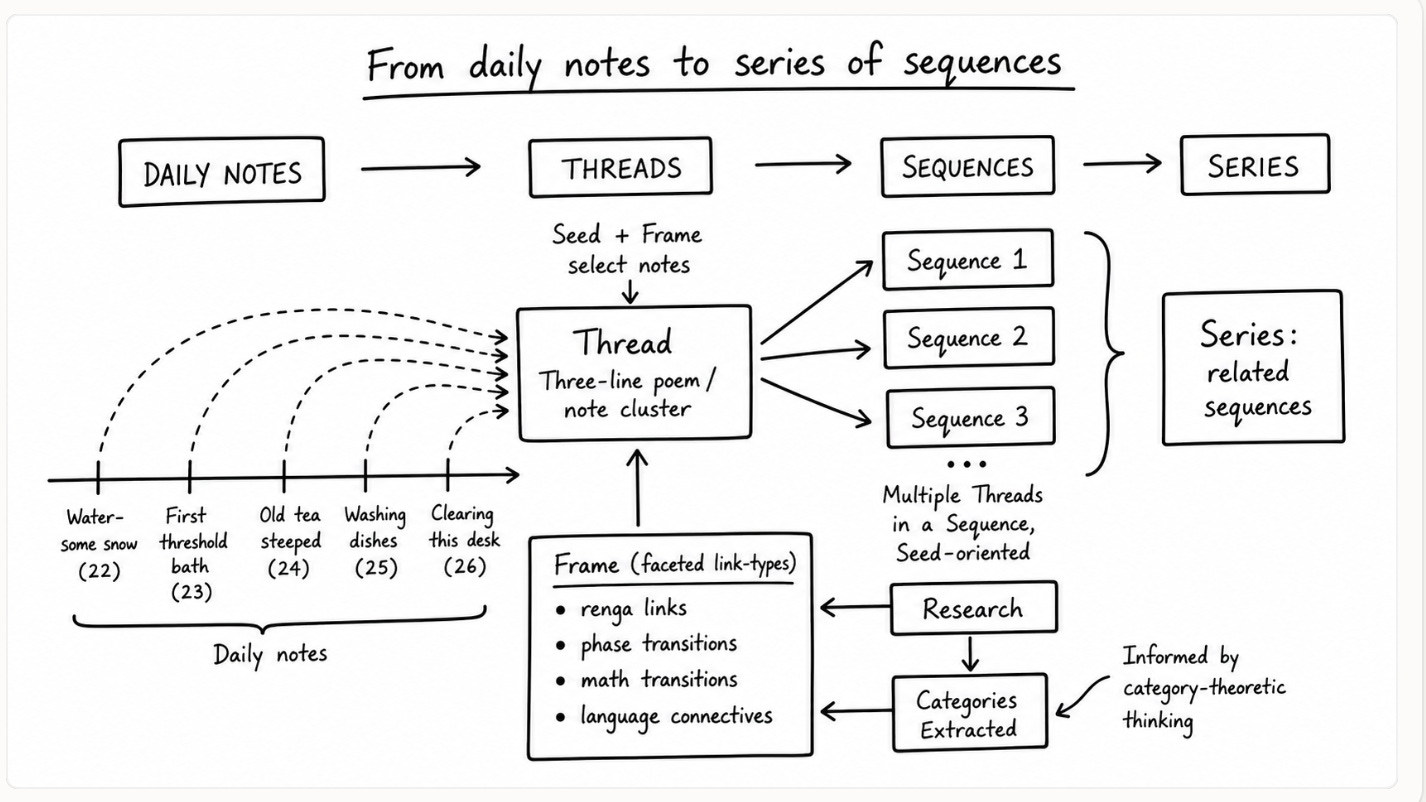
My current vocabulary for this is …
Note: A three line ‘poem’ or something less, somewhat influenced by haiku.
Thread: A series of notes.
Sequence: A series of threads, often organised around a seed text.
Skein: A thread based on a series of threads, weaving them together. Called ‘mycelium’ when it happens in Interobjective: Writing as hyperobject 5. For now I will be calling these skeins as a skein is a collection of threads doubled or knotted.
Seed: A text used with a frame to inform the selection and sequencing of notes into a thread
Frame: A faceted taxonomy (a simple ontology) used to define different types of links between notes in a thread. I am experimenting with several different frames and ways of organizing frames.
Seed + Frame selects Notes for a Sequence of Threads
Series is a set of related Sequences
Frames are interesting to me. They connect my interest in ontologies (in the sense of how we organize and connect information) and chance with generation and self organization.
I am going to do more work developing alternative frames and ways to apply them. In future sequences I will look for ways to surface the link descriptions into the work.
Writing as hyperobject uses my first attempt at a Frame.
I began with a 149 page context document, summarised below. I then condensed that into something more usable, the full frame is shared below.
“The document designs an ontology of “linking” to guide AI in sequencing short, haiku-derived notes so they form meaningful, non-linear threads. It does this by importing and systematizing four main frameworks:
Classical Japanese renga theory: a detailed taxonomy of verse-to-verse links (lexical, content, and “scent”/atmospheric) plus distance (close vs distant links) and structural rules (shifts, topic spacing, jo–ha–kyū) to keep sequences mobile and suggestive rather than narrative and fixed.
Mathematical semiotics: a seven-class taxonomy of signs (nominal, operational, relational, logical, quantificational, definitional/meta, structural) that distinguishes objects, operations, propositions, and meta-level organization, offering a grammar for how “expressions” of any kind can be linked and transformed.
Phase-transition theory: an ontology of change (order parameters, symmetry breaking, first- vs second-order transitions, criticality, universality) that reframes how sequences move between regimes—when a theme “switches phase” or a thread enters a critical region where small linking changes reorder global structure.
Cross-linguistic connectives: a semantic and formal taxonomy of discourse relations (additive, adversative, causal, temporal, conditional, etc.) across many languages and morphosyntactic strategies, providing a catalog of how one fragment can be made to stand in relation to another in discourse.
Across these, the core idea is to treat each link between notes as a typed object in a shared ontology (poetic, logical, physical, and linguistic at once), so that AI can generate and navigate rich, multi-perspectival sequences rather than simple chains.”
149 pages is too long to use for my. purposes, so I condensed this down into 24 types of link.
1. Direct Echo
Facets: LEXICAL · CONTENT · DISTANCE–NEAR
Use when Note B repeats or slightly varies a salient word, image, or concrete detail from Note A.
The second note feels like an immediate echo or reflection: the reader clearly sees “the same thing, shifted slightly” (e.g. moon → same moon in different position).
2. Codified Association
Facets: LEXICAL · CULTURAL · DISTANCE–NEAR
Use when Note B picks up a conventional pair or “codified” association from Note A (warbler → plum blossom; autumn → moon; exile → sea).
This brings in the classical yoriai / hon’i spirit: B inherits a ready-made cultural script or seasonal essence from A.
3. Field Association
Facets: LEXICAL · SEMANTIC–FIELD · DISTANCE–MEDIUM
Use when Note B chooses another element from the same semantic field as A (bow → arrow; ship → harbor; code → bug).
The link is not a fixed pair but a shared world; it feels like walking to another object in the same room.
4. Pivot Word Shift
Facets: LEXICAL · AMBIGUITY · DIRECTION–SIDEWAYS
Use when a word or phrase in Note A allows two readings and Note B commits to the alternative, or plays on sound/meaning.
This compresses kakekotoba and torinashi-zuke: B “turns” the hinge word and reveals a second semantic doorway (matsu: pine/wait; bay/resentment, etc.).
5. Function / Aspect Link
Facets: CONCEPTUAL · PART–WHOLE · DISTANCE–NEAR
Use when Note B focuses on a function, property, or component of something in A (bow → stretching; city → sirens; cloud → shadow).
This creates a close, almost metonymic motion: we zoom into one operational aspect of what was previously whole.
6. Narrative Continuation
Facets: CONTENT · TEMPORAL–FORWARD · DISTANCE–NEAR
Use when Note B continues, extends, or lightly explicates the scene, situation, or story implied in A.
Simple examples: next moment, tomorrow, another view in the same place, the next sentence in a micro-story, etc.
7. Omitted Center
Facets: CONTENT · OMISSION · DISTANCE–MEDIUM
Use when A and B share a narrative or situational link that is never named directly.
The reader must infer the connecting figure or event (e.g. soldiers marching → a house in disarray, with doctor and patient implied but unstated). The joint is felt as a gap that nonetheless “clicks.”
8. Scent / Atmosphere Drift
Facets: AFFECTIVE · ATMOSPHERIC · DISTANCE–FAR
Use when Note B does not follow A’s story or words, but shares its mood, temperature, or existential color.
This is nioi / yosei: A’s “emotional air”—solitude, fatigue, erotic tension, dread—quietly persists in an entirely different scene in B.
9. Reverberation / Shock
Facets: AFFECTIVE · INTENSITY–HIGH · DISTANCE–MEDIUM
Use when the emotional force of Note A (violence, breakage, sudden decision) resounds in a different but equally charged situation in B.
The joint is not narrative but energetic: a smashed bowl → a twisting sabre; an argument → a door slammed by the wind.
10. Transference / Reflection
Facets: AFFECTIVE · MIRRORING · DIRECTION–BIDIRECTIONAL
Use when A and B seem to mirror or transpose one another: the quality in A appears in B under a new guise, and the two illuminate each other in retrospect.
It can be gentle (erotic atmosphere → court scene) or stark (blunt physical blow → violent winter weather). The two notes form a reflective dyad.
11. Social Rank / Status Parallel
Facets: CONTENT · SOCIAL · DISTANCE–MEDIUM
Use when Note B matches A by social level, class markers, or “rank” (humble food → humble work; luxury interior → aristocratic gesture).
This can be combined with other facets: a kurai-like echo establishes a social equivalence even when content otherwise shifts.
12. Cultural Trace / Nostalgia
Facets: CULTURAL · MEMORY · DISTANCE–FAR
Use when Note B carries the “ghost” or afterimage of a figure, era, or story only implied by A.
There is no explicit allusion; instead, a shared cultural halo (omokage / honkadori without quotation) connects them, like two different films both haunted by the same myth.
13. Place / Setting Weave
Facets: SPATIAL · ATMOSPHERIC · DISTANCE–NEAR
Use when Note B either:
Places a new action in the environment implied by A, or
Reconstructs the environment of A from an action or object in B.
This is keiki: the setting becomes the hidden thread; the camera moves but the weather and architecture hold the chain together.
14. Seasonal / Elemental Continuity
Facets: SEASONAL · ELEMENTAL · STRUCTURAL
Use when Note B maintains or reactivates the same season, natural element, or hon’i (moon → loneliness; autumn insects → transience) established in A.
This is a generalized kigo / hon’i link: the shared seasonal or elemental essence is the binding field.
15. Distance Leap (Near → Far)
Facets: DISTANCE–FAR · COGNITIVE-GAP · DIRECTION–FORWARD
Use when you deliberately insert a large logical, narrative, or imagistic gap between A and B, inviting the reader to supply the bridge.
Think soku or a first/second-order phase jump: the notes feel discontinuous, but some deeper pattern (tone, theme, topology) makes the leap legible. Use sparingly to avoid pure randomness.
16. Structural Pivot / Volta
Facets: STRUCTURAL · PERSPECTIVE · DIRECTION–TURN
Use when Note B “turns” from the mode or stance of A: description → reflection, outer scene → inner thought, impersonal → personal.
This generalizes the tanka pivot and volta: we remain near in content, but the relation to that content changes (from seeing to being, from thing to judgment).
17. Elegant Confusion / Double Image
Facets: IMAGISTIC · ANALOGY · AMBIGUITY
Use when Note B overlays a second image on the first by way of a perceived “mistake” or mirroring (snow as blossoms; neon as rain).
This integrates mitate with scent-linking: B doesn’t explain; instead, it reveals that A was always already “also something else.”
18. Operational / Imperative Shift
Facets: LOGICAL–OPERATIONAL · DIRECTION–PROCESS · META
Use when Note B feels like a transformation “command” applied to A: inversion, negation, scaling, differentiation, limit-taking, reordering.
The connection is procedural: if A is x, B is “f(x)”—a consequence, derivative, or recombination. This borrows from mathematical operational signs and Rotman’s imperative reading of equations.
19. Conditional / Counterfactual Step
Facets: LOGICAL–CONDITIONAL · MODAL · DIRECTION–BRANCH
Use when Note B presents a condition, alternative, or counterfactual relative to A (“if this were otherwise,” “in another timeline,” “unless this breaks”).
Think of it as moving from proposition to its modal neighbor: A is the world; B is the adjacent possible or forbidden variant.
20. Phase / Threshold Crossing
Facets: PHASE-TRANSITION · INTENSITY–CRITICAL · DIRECTION–THRESHOLD
Use when Note B marks a qualitative shift in the “state” implied by A: solid → liquid, crowd → stampede, flirtation → confession, attention → exhaustion.
The sequence passes a critical point: the order parameter of the poem changes—temperature, density, social configuration, emotional coherence.
21. Symmetry Breaking
Facets: PHASE-TRANSITION · SYMMETRY · DIRECTION–IRREVERSIBLE
Use when A presents a balanced, symmetric, or reversible situation, and B introduces an asymmetry that chooses one side (a decision, a crack, a preference, a bias).
This can be very quiet (an almost identical scene with one small difference that “chooses”) or abrupt (the poem picks a side, a voice, a direction).
22. Scale Shift / Renormalization
Facets: SCALE · META · DIRECTION–IN/OUT
Use when Note B moves up or down in scale relative to A: micro → macro, personal → planetary, leaf → forest, line → system.
The connection is that B is “the same process seen at another length scale,” echoing RG ideas: weather → climate; twitch → culture; a single note → the entire sequence as hyperobject.
23. Topic Reallocation / Re-entry
Facets: STRUCTURAL · RECURSIVE · DISTANCE–LONG
Use when Note B recalls a theme, image, or motif not just from A, but from an earlier point in the sequence, respecting some spacing rule.
This condenses uchikoshi, sarikirai, kukazu, and kakari/musubi: B re-enters an earlier topic after an interval, creating an arc or ring without immediate repetition.
24. Discourse / Sequence Steering
Facets: META · PHRONETIC · DIRECTION–GUIDING
Use when Note B comments on, redirects, or changes the pacing or framing of the sequence itself—slowing, quickening, closing, or opening a new movement.
This is a generalization of jo–ha–kyū: B may feel like prelude, expansion, or rush to closure, even if content is minimal. It’s less “about” A than about where the sequence wants to go next.
That is as far as I have gone for the Writing as hyperobject series. I am exploring two other approaches. I have applied category theory to the above ontology as a formalism and then regenerated a new Frame based on the cateogry theory interpretation (see below). I have also taken a different approach using musical transitions as the linking ontology. I will be playing with both of these over the next few weeks.
Category theory
This follow-up reframes the Connecting Notes system as an explicit categorical architecture for sequencing three-line notes.
Core categorical picture
Notes form a category NN: notes are objects, the 24 transition types are morphisms, sequences are composed chains of morphisms, and note self-repetition is the identity.
Because each transition carries multi-axis facets (type, distance, direction, domain), hom-sets are enriched objects, not flat sets; NN is an enriched category over a monoidal “facet space.”
Higher level structure
The seed text is a functor from a category of themes TT into NN, mapping thematic structures to subcategories of notes and licensed transitions; different sequencing logics correspond to different functors, comparable via natural transformations.
The 24 transitions act as generators of a colored operad; compound transitions are operadic compositions, and the actual morphism space is the free algebra over this operad.
Topology, metrics, and filtering
Sequences are paths in NN that also trace shapes in a simplicial complex (“locally legible, globally strange” topology).
Distance facets define a Lawvere metric on transitions, enabling path-length control and jo–ha–kyū pacing as a filtered category of stages (intro, break, rapid close).
Meta-level: document and hyperobject
The synthesis document is treated as a presheaf on NN, returning all licensed predecessors into any note; the seed acts as a section of this presheaf.
Using a “hyperobject” lens, the full note repository is seen as approximating a categorical limit: each sequence is a colimit-like partial view of a virtual “universal note.”
Practical upshot
Making this categorical structure explicit (facet vectors, seed-as-category, operad rules, filtered sequencing, metric path-planning) would turn the poetic protocol into a mathematically grounded engine for AI sequencing, where each note’s identity is defined by its web of transitions rather than intrinsic content.
Musical transitions
This is a different approach to Note linking based on music. Have made a few experiments with this and expect to use it to generate future sequences. It has 28 transitions from various musical cultures.
Preamble: From Music to Text
Each of the 28 musical phrase transitions carries a structural logic that operates independently of its sonic medium. A Perfect Authentic Closure is not fundamentally about V→I harmony; it is about the discharge of accumulated expectation into settled ground. Translated to text, that logic governs how one three-line note (a haiku-like unit of compressed observation) yields to the next. The musical facets — boundary modality, syntactic mechanism, semantic valence, temporal profile, spatial register, agency, granularity, and continuity — map onto textual dimensions with near-perfect fidelity, because both systems are, at base, grammars of how attention moves through time.
The 28 transitions are rendered below as mediator descriptions: instructions for the relationship between two notes. Each mediator tells you what structural and semantic work the transition must do. For any pair of candidate notes, you can evaluate whether a given mediator fits, making the taxonomy a link-finding instrument: for one note, scan the mediator set to find which transitions are plausible, and thereby discover which other notes could follow.
Each entry gives:
Name and Group (from the musical taxonomy)
Mediator Description: what the transition does between notes, in prose
Linking Question: the diagnostic question to ask of a candidate next-note
Facet Profile: the eight-facet vector for retrieval/filtering
Group A — Cadential (Closure) Transitions
These mediators move between notes through degrees of resolution — from full settlement to deliberate suspension.
A1 · Perfect Authentic Closure
Mediator: The first note has been moving — building an image, a tension, a mood. The second note lands: it arrives on firm ground, fulfils what the first implied, and settles. The reader exhales. Nothing is left unresolved; the second note begins from stillness, not from momentum.
Linking Question: Does the candidate note complete what this note began, arriving at rest rather than launching something new?
Facet Profile: BM:Discrete · SM:Harmonic · SV:Closure · TP:Compressed · SR:Descent · AG:Composer · GR:Phrase · CO:Varied
A2 · Half-Cadential Suspension
Mediator: The first note ends on an open syllable — a question held in the air, a perception not yet interpreted. It is complete as a statement but incomplete as an argument. The second note is syntactically required: the suspension demands an answer. The link is one of inhalation before speech.
Linking Question: Does the candidate note answer the question this note is holding open — not by restating it but by resolving its incompleteness?
Facet Profile: BM:Discrete · SM:Harmonic · SV:Opening/Expectation · TP:Extended · SR:Stationary · AG:Composer · GR:Phrase · CO:Varied
A3 · Deceptive Deflection
Mediator: The first note promises a particular landing — a familiar image, a predictable turn — and the second note arrives somewhere else entirely. The reader expected resolution; instead they find themselves re-oriented, the prior note recontextualised by the surprise. Both notes remain valid; what changes is the relationship between them.
Linking Question: Does the candidate note redirect or reframe what this note seemed to be heading toward, arriving somewhere unexpected without violating either note’s integrity?
Facet Profile: BM:Discrete · SM:Harmonic · SV:Surprise/Deflection · TP:Extended · SR:Lateral · AG:Composer · GR:Phrase · CO:Contrasting
A4 · Modal Cadence (Raga Close)
Mediator: The first note descends through specific, characteristic imagery — a sequence of images that identify its world (its “raga”) — and arrives at a grounded, drone-like stillness. The second note does not begin with new energy; it rises from that stillness, as if the silence between them is the same root note. The transition is a return to ground before a new journey.
Linking Question: Does the candidate note emerge from the same atmospheric “root” as this note, departing from shared stillness rather than contradicting it?
Facet Profile: BM:Gradual · SM:Modal · SV:Closure · TP:Continuous-Drift · SR:Descent · AG:Tradition-Encoded · GR:Phrase · CO:Varied
A5 · Plagal Extension
Mediator: The first note has already resolved — the thought is complete, the image landed. But then a coda: a small, soft addition, an “amen,” a final exhale. The second note inherits this post-resolution stillness. It begins not from energy but from quiet redundancy that has become its own kind of spaciousness.
Linking Question: Does the candidate note follow naturally from a surplus of quietness — from a note that said more than it needed to and left an afterglow?
Facet Profile: BM:Discrete · SM:Harmonic · SV:Closure · TP:Extended · SR:Descent · AG:Composer · GR:Phrase · CO:Continuous
Group B — Temporal Boundary Manipulations
These mediators reshape the location and feel of the boundary in the reader’s attention.
B1 · Elision
Mediator: The last word (or image, or beat) of the first note is simultaneously the first word of the second. There is no gap. The transition point is a single shared moment that belongs to both notes: it closes the first and opens the second in the same instant. The reader experiences a slight jolt — a double-exposure — and then realises the economy of it.
Linking Question: Is there a word, image, or grammatical unit in this note that could serve as the opening move of the next — shared by both without belonging exclusively to either?
Facet Profile: BM:Discrete · SM:Harmonic · SV:Closure/Opening · TP:Compressed · SR:Stationary · AG:Composer · GR:Phrase · CO:Continuous
B2 · Dovetail Overlap
Mediator: The second note begins to speak before the first has finished. A new image, a new syntactic thread enters while the prior note’s resonance is still active. The reader holds two simultaneous streams momentarily — a textural overlap — before the first fades and only the second remains.
Linking Question: Could the candidate note begin mid-thought, with the reader still partially inside this note — the two notes briefly superimposed before one wins the foreground?
Facet Profile: BM:Distributed · SM:Harmonic · SV:Opening/Expectation · TP:Extended · SR:Ascent · AG:Composer · GR:Phrase · CO:Continuous
B3 · Extension–Deferral
Mediator: The expected turn never quite arrives. The first note circles its subject — repeating, elaborating, delaying — building pressure through accumulation. The second note finally lands the transition that was promised from the start, its arrival made more powerful by having been withheld.
Linking Question: Does the candidate note deliver a landing that this note has been deferring — arriving with increased weight because it was late?
Facet Profile: BM:Discrete · SM:Harmonic · SV:Opening/Expectation · TP:Extended · SR:Stationary · AG:Composer · GR:Phrase · CO:Continuous
B4 · Phrase Contraction
Mediator: The first note ends earlier than expected — it cuts itself short, stops before completing its implied arc. The second note enters abruptly, into a space that hasn’t been fully prepared. The effect is urgency, acceleration, a sense that something is approaching faster than anticipated.
Linking Question: Does the candidate note arrive into an unprepared space — following a note that ended before finishing — creating an effect of compressed time or forward pressure?
Facet Profile: BM:Discrete · SM:Harmonic · SV:Surprise/Deflection · TP:Compressed · SR:Stationary · AG:Composer · GR:Phrase · CO:Contrasting
B5 · Jo-Ha-Kyū Transition
Mediator: The first note accelerates into its ending — the imagery densifies, the rhythm tightens — and then stops abruptly, as if the breath ran out. The second note begins in a completely different temporal register: slow, open, exploratory, as if time has been reset. The transition is a break, a rupture, and a new becoming from stillness.
Linking Question: Does the candidate note open a new temporal world — slow and spacious — after this note has rushed to an abrupt end?
Facet Profile: BM:Discrete · SM:Cyclic · SV:Emptiness/Presence · TP:Accelerating · SR:Stationary · AG:Tradition-Encoded · GR:Phrase/Section · CO:Contrasting
B6 · Phase Drift
Mediator: The first and second notes are nearly identical — the same images, the same rhythm, the same world — but slightly displaced: a word has shifted, a line-break moved, an emphasis realigned. The reader cannot identify a discrete moment of change; the notes drift apart like two clocks keeping slightly different time, and a new composite meaning emerges from their growing divergence.
Linking Question: Does the candidate note repeat this note’s essential content but with a barely perceptible displacement — so that the difference only becomes legible across the sequence?
Facet Profile: BM:Absent/Void · SM:Process · SV:Neutral/Objectified · TP:Continuous-Drift · SR:Stationary · AG:System-Governed · GR:Phrase · CO:Continuous
B7 · Additive Process
Mediator: Each note is the previous note plus one element. An image is added, a qualifier appended, a new sensory dimension opened. The transition is incremental: the reader feels the note getting richer, heavier, more complex with each iteration, while the core remains the same. The sequence is a slow accumulation into fullness.
Linking Question: Can the candidate note be understood as this note with one new element added — the same core, one dimension deeper?
Facet Profile: BM:Gradual · SM:Process · SV:Deepening · TP:Continuous-Drift · SR:Stationary · AG:System-Governed · GR:Phrase · CO:Continuous
Group C — Spatial and Registral Transitions
These mediators move between notes by shifting the level, colour, or location of attention.
C1 · Registral Ascent
Mediator: The second note inhabits a higher register than the first — not necessarily higher in pitch but higher in abstraction, lighter in texture, further from the ground. The transition is an elevation: from the concrete to the conceptual, from the body to the air, from the particular to the general.
Linking Question: Does the candidate note operate at a higher level of abstraction, airiness, or distance than this note — ascending away from its material ground?
Facet Profile: BM:Discrete · SM:Modal · SV:Opening/Expectation · TP:Static · SR:Ascent · AG:Performer · GR:Phrase · CO:Contrasting
C2 · Registral Descent
Mediator: The second note drops into a lower register — denser, heavier, more material, closer to the earth or the body. Where the first note may have been airy or abstract, the second grounds it: a concept becomes a sensation, a generality becomes a specific thing.
Linking Question: Does the candidate note descend into more concrete, bodily, or earthy material than this note — grounding what was floating?
Facet Profile: BM:Discrete · SM:Modal · SV:Closure · TP:Static · SR:Descent · AG:Performer · GR:Phrase · CO:Contrasting
C3 · Timbral Shift
Mediator: The second note carries the same structural content as the first but in a different voice quality — a different emotional register, a different mode of address. The same thought, suddenly cold where it was warm; lyrical where it was declarative; ironic where it was earnest. The transition is a recolouring of the same material.
Linking Question: Could the candidate note express a similar observation to this note but in a completely different emotional tone or mode of address — same object, different light?
Facet Profile: BM:Discrete · SM:Modal · SV:Surprise/Deflection · TP:Static · SR:Lateral/Timbral · AG:Composer · GR:Phrase · CO:Varied
C4 · Spatial Displacement (Antiphonal)
Mediator: The second note comes from a different voice entirely — a different speaker, a different spatial position in the conversation. The first note spoke from one location (a season, a body, a viewpoint); the second answers from across the room (a contrasting season, a different body, an opposing viewpoint). The transition is a spatial handoff between perspectives.
Linking Question: Does the candidate note occupy a different perspective, speaker-position, or spatial location than this note — responding from across a gap rather than continuing from the same place?
Facet Profile: BM:Discrete · SM:Social/Dialogic · SV:Opening/Expectation · TP:Static · SR:Physical-Spatial · AG:Ensemble-Coordinated · GR:Phrase · CO:Antithetical
Group D — Ornamental and Micro-Level Transitions
These mediators operate at the level of individual words or images but accumulate into phrase-level movement.
D1 · Gamaka Glide
Mediator: The last image of the first note does not end cleanly — it slides into the first image of the second note through a continuous chain of association, colour, or sound. The reader cannot identify where one note ends and the next begins; the boundary is a smear of continuous movement. The transition is felt in the body as a glide rather than a step.
Linking Question: Is there a word, colour, sound, or sensation at the end of this note that flows continuously into the opening image of the candidate note — with no gap, only motion?
Facet Profile: BM:Gradual · SM:Modal · SV:Deepening · TP:Continuous-Drift · SR:Descent/Ascent · AG:Performer · GR:Micro · CO:Continuous
D2 · Oscillatory Dissolution
Mediator: The first note ends on an image held in suspension — trembling, oscillating, refusing to resolve. It neither completes nor releases. The reader is held in a state of ambiguity — between two possible meanings, two possible continuations. The second note finally emerges from this dissolution, crystallising what was suspended.
Linking Question: Does the candidate note crystallise or resolve an image that this note left suspended in ambiguity — emerging from its unresolved oscillation?
Facet Profile: BM:Gradual · SM:Modal · SV:Emptiness/Presence · TP:Extended · SR:Stationary · AG:Performer · GR:Micro · CO:Continuous
D3 · Sangati Variation
Mediator: The second note is not a new note — it is a deeper reading of the same note. The same essential observation, the same world, but now with finer detail, richer ornamentation, or an extended implication that was latent in the first note but not yet realised. The transition is from statement to commentary, from sketch to painting.
Linking Question: Does the candidate note take this note’s core image and deepen, enrich, or elaborate it — adding ornamental complexity to the same essential perception?
Facet Profile: BM:Discrete · SM:Modal · SV:Deepening · TP:Extended · SR:Ascent · AG:Performer · GR:Phrase · CO:Varied
Group E — Silence and Void Transitions
These mediators make the space between notes itself into active material.
E1 · Ma Pause (Active Silence)
Mediator: Between the first and second notes there is a silence that is not empty — it is charged with the resonance of what just was and the anticipation of what is about to be. The white space between the notes is read as a held breath, a threshold moment. The reader dwells there. The second note does not fill the silence so much as emerge from it.
Linking Question: Does the candidate note feel like it is emerging from silence rather than following noise — born from the acoustic afterglow of this note rather than answering it?
Facet Profile: BM:Absent/Void · SM:Tradition-Encoded · SV:Emptiness/Presence · TP:Static · SR:Stationary · AG:Tradition-Encoded · GR:Phrase · CO:Contrasting
E2 · Breath Cadence
Mediator: The transition is a breath. The first note uses up the air — it is as long as one exhalation. The second note begins with the next inhalation. The boundary is physiological: the reader feels it in their chest. The link between notes is the rhythm of a body reading, not a logic connecting their contents.
Linking Question: Can the candidate note follow this one as naturally as one breath follows another — connected by the rhythm of reading rather than by meaning?
Facet Profile: BM:Discrete · SM:Social/Dialogic · SV:Closure · TP:Compressed · SR:Stationary · AG:Solo-Performer · GR:Phrase · CO:Varied
E3 · Resonance Decay
Mediator: The first note ends on a long, resonant image — a sound, a light, a word that continues to vibrate after the note ends. The second note enters during that reverberation, not after it. The two notes overlap in acoustic time: the decay of the first is the opening atmosphere of the second.
Linking Question: Does the candidate note begin inside the still-vibrating space of this note — entering before the resonance has fully died, rather than after silence?
Facet Profile: BM:Gradual · SM:Tradition-Encoded · SV:Emptiness/Presence · TP:Extended · SR:Stationary · AG:Tradition-Encoded · GR:Phrase · CO:Continuous
Group F — Cyclic and Structural Transitions
These mediators govern higher-level formal boundaries — where a whole phase of meaning completes and another begins.
F1 · Gong Cycle Closure
Mediator: The first note is the culmination of a long accumulation — the point toward which everything in the sequence has been moving. It arrives with the weight of a structural arrival, not just a local completion. The second note begins a new cycle from zero: fresh, unhurried, as if the accumulation were wiped clean. The transition is a formal reset, not an emotional resolution.
Linking Question: Does this note feel like the completion of a long arc — so that the candidate note begins an entirely new world, not a continuation of the old one?
Facet Profile: BM:Discrete · SM:Cyclic/Colotomic · SV:Closure · TP:Cyclically-Reset · SR:Stationary · AG:Tradition-Encoded · GR:Cycle/Form · CO:Continuous
F2 · Call–Response Handoff
Mediator: The first note raises a question, observation, or challenge that is explicitly social — it speaks to someone, or about something that demands a communal acknowledgment. The second note is the answer: not a development but an agreement, a witnessing, a formulaic affirmation that closes the exchange. The transition is a social contract enacted in language.
Linking Question: Does the candidate note agree with* or witness what this note raised — responding as a chorus rather than an individual, confirming rather than developing?*
Facet Profile: BM:Discrete · SM:Social/Dialogic · SV:Closure/Opening · TP:Static · SR:Physical-Spatial · AG:Ensemble-Coordinated · GR:Phrase · CO:Antithetical
F3 · Row Completion–Initiation
Mediator: The first note has deployed all the elements of its chosen “vocabulary” — every image, every word-type, every sensory domain has been used exactly once. The second note begins a new, equally complete vocabulary: the same or a transformed version of the set, restarted. The transition is formal and neutral: a grammar event, not an emotional one. The link is structural, not thematic.
Linking Question: Does the candidate note begin a new complete pass through a defined set of elements — starting the same vocabulary over, or in a transformed version — while this note exhausts its prior pass?
Facet Profile: BM:Discrete · SM:Row-Governed · SV:Neutral/Objectified · TP:Compressed · SR:Stationary · AG:Composer · GR:Phrase/Section · CO:Contrasting
F4 · Turnaround
Mediator: The first note performs a short, formulaic closing gesture that simultaneously resets momentum for what comes next. It says: this is ending, but we are not stopping. It is a double-hinge — backwards compatible (it closes) and forward propulsive (it launches). The second note arrives with renewed energy, not because anything changed, but because the turnaround renewed the engine.
Linking Question: Does the candidate note arrive with fresh propulsive energy after this note’s closing gesture — as if the reset were sufficient to launch an entirely renewed forward motion?
Facet Profile: BM:Discrete · SM:Harmonic · SV:Opening/Expectation · TP:Compressed · SR:Stationary · AG:Performer · GR:Phrase/Section · CO:Continuous
F5 · Modulation
Mediator: Between the first and second notes, the tonal world shifts. The second note inhabits a different key — a different set of assumptions, associations, or cultural registers. The reader must recalibrate: the same words mean different things now; the same images carry different weight. The transition is not emotional but conceptual: a change of interpretive frame.
Linking Question: Does the candidate note operate within a different conceptual, cultural, or semantic frame than this note — so that the reader must shift their interpretive key to enter it?
Facet Profile: BM:Discrete · SM:Harmonic · SV:Surprise/Deflection · TP:Compressed · SR:Lateral · AG:Composer · GR:Section · CO:Contrasting
Group G — Indeterminate and Emergent Transitions
These mediators dissolve the control of any single author over where the boundary falls.
G1 · Performer-Determined Boundary
Mediator: The transition exists only in the reading, not on the page. No structural feature of either note specifies the boundary — the reader decides, in the act of reading, when the first note is “done” and the second begins. Two readers of the same pair of notes may draw the boundary differently; both are valid. The meaning of the transition is inseparable from the act of individual interpretation.
Linking Question: Can the candidate note follow this one with the boundary drawn differently by each reader — so that where one reader ends this note and where another does produces two different but equally valid sequences?
Facet Profile: BM:Absent/Void · SM:Indeterminate · SV:Neutral/Objectified · TP:Static · SR:Stationary · AG:Solo-Performer · GR:Phrase · CO:Indeterminate
G2 · Ensemble-Emergent (Kotekan/Hocket)
Mediator: Neither note is complete on its own — each is a partial statement that only makes full sense in combination with the other. The transition is not a link between two wholes but the emergence of a single whole from two partial lines. The reader must hold both notes simultaneously to perceive the composite meaning; the “transition” is the act of integration.
Linking Question: Is the candidate note incomplete without this note — so that only the reader who holds both simultaneously will perceive a meaning that neither note contains alone?
Facet Profile: BM:Distributed · SM:Process · SV:Neutral/Objectified · TP:Continuous-Drift · SR:Stationary · AG:Ensemble-Emergent · GR:Phrase · CO:Continuous
G3 · Angsel (Coordinated Punctuation Break)
Mediator: A sudden, collective stop. Both notes agree — in the same instant — to interrupt forward motion and mark the boundary with emphasis. The break is not a failure of momentum but an assertion: this is where the seam is. The second note begins from shared silence into which all parties have consciously arrived.
Linking Question: Does the transition between this note and the candidate note feel like a jointly-agreed interruption — a clean, emphatic seam that both notes acknowledge?
Facet Profile: BM:Discrete · SM:Social/Dialogic · SV:Surprise/Deflection · TP:Compressed · SR:Stationary · AG:Ensemble-Coordinated · GR:Phrase · CO:Contrasting
References
Cheng, Eugenia (2022) The Joy of Abstraction: An Exploration of Math, Category Theory, and Life. Cambridge University Press.
Harman, Graham (2018) Object-Oriented Ontology: A New Theory of Everything. Pelican, London.
Morton, Timothy (2013), Hyperobjects: Philosophy and Psychology After the End of the World. University of Minnesota Press.
Ranganathan, S. R. (1960) Colon Classification: Basic Classification (6th editon). Ess Ess Publications.
Sowa, John (1999) Knowledge Representation: Logical, Philosophical, and Computational Foundations. Brooks / Cole.
An interpretation of the Writing as Hyperobject Series - done in conversation with the Perplexity AI, edited and revised. Generated and edited June 17, 2026.
The Structural Spine: Morton’s Five Properties
The series’ architecture is not metaphorical but architectonic. Timothy Morton’s Hyperobjects (2013) identifies five defining properties of entities too massively distributed in time and space to be fully grasped: viscosity, nonlocality, temporal undulation, phasing, and interobjectivity. The Folding Notes posts take each property as both a title and a formal constraint — the poem must perform the property it describes. This is the core conceit: the series does not explain hyperobjects, it tries to be one.
The prefatory post, Flat Ontologies, sets the philosophical stage. Drawing on Graham Harman’s formulation — “all objects are equally objects” and “human beings are not different in kind from all non-humans” — it proposes a poetics of democratic thing-hood. The pivot from Harman to Francis Ponge is exact: The Making of the Pré (1971) is cited as a “lived example of a flat ontology,” in which the meadow (a real object, in Harman’s terms) shapes the text as much as the writer does. The distinction between real objects — which withdraw from every encounter, never fully accessible — and sensual objects — which exist only within a relation — becomes the series’ deepest conceptual engine. Writing is posed as an attempt to traverse the gap between them, always incomplete.
How the Series Develops
Viscosity (Post 1) opens in pure materiality. Morphemes and sememes “stick to each other”; language has a physical consistency. The poetry here is deliberately granular — acid reflux, dust, capillary action, breath vapour, Cantor dust, color spaces between RGB and CMYK. The reference to Wittgenstein’s Remarks on Colour deepens this: color, like language, cannot be fully systematized; there are always regions that slip between any two grids of representation. The poem’s form — short, interlocked, recombinant notes — is the viscosity it describes: fragments adhere to each other, resist easy extraction.
Nonlocality (Post 2) shifts from matter to measurement. Drawing on the Heisenberg uncertainty principle and the canonical commutation relation XP−PX=iℏ/2π, it asks: the more locally precise language becomes, the more it loses context; the more general, the less it belongs to any particular conversation. Vygotsky’s inner speech — condensed, predicate-without-subject — is identified as the natural condition of the short note, the haiku-like form. Crucially, this post introduces the series’ recurrent presence of illness: the esophageal cancer, the collapsed lung, the surgical recovery. The body is itself a nonlocal object — experienced as sensation here, measured by imaging from outside, distributed across hospitals, medical records, memory. Kobayashi Issa’s most devastating haiku — tsuyu no yo wa / tsuyu no yo nagara / sari nagara (”the world of dew / is the world of dew / and yet, and yet”) — is quoted with biographical awareness: Issa wrote it after his daughter’s death, acknowledging the Buddhist truth of impermanence while unable to surrender grief.
Undulation (Post 3) is the most formally inventive. Opening with an etymological descent into undulatus (wavy) from Klein’s comprehensive dictionary, it proposes that time itself undulates under the pressure of hyperobjects — that “what we call ‘before’ and ‘after’ are local inflections along the surface.” The renga 連歌 becomes the structural model: a linked verse form in which the nioi (scent) of the link can connect across vast temporal and spatial gaps. The poem weaves repeated motifs (water states, the three-body problem, Sierpinski gaskets, the “cracked symmetries” of aging) into overlapping threads. The Soseki reference to “the three-cornered world” — the artist living in the triangle after common sense has been removed from the four-cornered world — is a quiet key: these poems occupy that triangular remainder.
Phasing (Post 4) introduces phase space from physics and turns it toward phenomenology. Where Wittgenstein’s design grid for the Haus Wittgenstein worked locally but could never fully resolve globally, the poem moves through grids, shadows, penumbras, and what Marcel Duchamp called the infrathin — the infinitesimal difference between two almost identical states. The Lagrangian and Hamiltonian formulations of mechanics appear: not merely as decoration but as genuine analogues for the poem’s method, treating a sequence of notes as a trajectory through a configuration space. Steve Reich’s phasing technique — two identical patterns gradually drifting out of unison to produce emergent rhythms — is the musical parallel. The six threads of this post (cleaning a sink, shadow penumbras, states of water, grids, pain, practice and repetition) phase in and out of each other, sharing motifs that appear at different positions in different threads.
Interobjective (Post 5) is the summative and most expansive piece. The mycelium is its governing image: just as mycorrhizal networks connect forest trees by infiltrating roots, surrounding cells, or building arbuscular structures inside them, so poems connect to each other through varying degrees of intimacy. Three modes of connection — wrapping, infiltrating, building fractals of another’s structure — map onto three modes of poetic intertextuality: allusion, honkadori 本歌取り (in waka, the deep integration of a prior poem), and the full inhabitation of another tradition. The concept of temporal bandwidth — the range from past to future relevant to the present — is introduced via Pynchon’s Gravity’s Rainbow and the Long Now Project. Reading across cultures and centuries expands this bandwidth; the goal, stated directly, is to “have time snap” and live “unmoored in a very large present.”
Recurring Themes
Several threads run across all six posts and grow in complexity as the series progresses:
Water as the master element. Water appears in almost every poem, in every state: snow, tea, vapor, ice, rain, blood. It is the paradigmatic object that refuses definition — “water choosing / not choosing to / claim a state” — embodying śūnyatā (emptiness of self-existence) without requiring any philosophical scaffolding. The triple-point of water, where solid, liquid, and gas coexist at a precise temperature and pressure, becomes a recurrent image for the ontological condition of any object: never fully what it appears to be.
Mathematics as poetics, not illustration. Cantor dust, transfinite numbers, the square root of two, the density of rationals as a subset of the reals, the three-body problem, cosine similarity in embedding spaces — these are not metaphors. They are genuine structural analogues. The series proposes that the irrational vastly outnumbers the rational, that “virtually all of the real is irrational and can only be named” — and takes this as a statement about language, perception, and the ungraspability of objects.
Illness and the body as ontological crisis. The presence of surgery, pain, and physical vulnerability is not confessional decoration. It performs the argument: the body is experienced as withdrawing from itself, as nonlocal to its own experience, as phased — present in sensation, absent in understanding. The line “Afraid to not know, afraid / not to know, wandering / between worlds” is the series’ emotional core.
Repetition as method, not failure. The same phrases recur across posts (”Lying too flat / The acid creep burns,” “Gone given loss into / other selves,” “the rationals being / a dense subset of the reals / as a stone is to water”). This is not editing oversight but formal argument: repetition in a different context creates phase-shift; meaning modulates without the phrase changing. This is honkadori — the waka technique of quoting a prior poem to activate a new field of resonance.
LLMs as hyperobjects. The series contains an embedded poetics of machine learning: embeddings as nonlocal representations, cosine similarity as the structural analogue of renga’s link-and-shift, temperature as the parameter that dissolves rigidity. The argument — that a note can be represented as an embedding and then exists at some distance from every other note — imports the vocabulary of ML into a genuinely philosophical and poetic problem about the nature of textual objects.
Implications
The series enacts a post-humanist poetics without abandoning the human. Unlike much ecopoetics, which risks sentimentalizing non-human agency, this work keeps human suffering — illness, grief, loss — in full view, while insisting that a note, a meadow, a dust particle, and a dead child occupy the same flat ontological plane. This is Morton’s challenge made personal and formal at once.
It proposes that the note as a form is structurally isomorphic with the hyperobject. A note withdraws: “any note I can write is withdrawing from itself, from me, from you. That is its presence.” The three-line note, close to haiku but not identical (English syllabics differ; the kireji is enacted structurally rather than lexically), functions as a minimal unit that nonetheless carries multi-dimensional resonance. The kigo (season-word) logic is extended: each note carries not just seasonal reference but dimensional reference — a register-word that places it in its scale-moment across image, concept, body, time.
The series also stages a critique of linguistic completeness that converges Wittgenstein’s Proposition 7 of the Tractatus (”Of what one cannot speak one must pass over in silence”) with Buddhist śūnyatā and Derrida’s différance — meaning as always deferred, never fully present. But where Wittgenstein proposes silence, this series proposes the note: not silence but the minimal utterance that honors withdrawal by making itself small enough to leave room for what it cannot say.
The fitness landscape metaphor introduced in Interobjective is among the series’ most original contributions to poetics. Reading is reframed as a search strategy: smooth semantic landscapes reward gradient-following (slow close reading), while fractal landscapes require non-local moves, deliberate descents, provisional readings that are abandoned rather than settled. The series is explicitly designed as a fractal landscape — every note, examined closely, exhibits the same structure of indeterminacy as the whole.
Connections
The web of connections the series activates is extraordinarily wide:
Poetry and Poetics
Francis Ponge — Le parti pris des choses and The Making of the Pré are the ur-texts of this objectivist poetics. Ponge’s method of exhaustive description that never reaches the object is precisely what the series performs in reverse: not exhaustive but minimal, trusting the three-line note to gesture toward what cannot be said.
Paul Celan — The Atemwende (breath-turn) as a poetic hinge, and the Meridian speech’s account of poetry as the encounter with otherness that returns one to oneself. Celan’s serial, sparse later work (Breathturn into Timestead) is the closest single antecedent in European poetry.
Emily Dickinson — Sharon Cameron’s Choosing Not Choosing (on the fascicles as deliberate non-selection) is cited: the undecidability of Dickinson’s punctuation and line-breaks as a formal enactment of quantum superposition.
Kobayashi Issa — The sari nagara (”and yet”) of grief-without-resolution is the series’ emotional model: Buddhist acknowledgment of impermanence that does not dissolve into acceptance.
Sōgi, Shōhaku, and Sōchō — The Three Poets at Minase (1488), the canonical renga, is cited as the formal template for link-and-shift sequencing.
Visual Art
Wang Jianwei — The Chinese artist’s statement that “my work hinges on the fact that I can never exhaust its existence” opens the series, and his practice of assembling heterogeneous materials resonates with the series’ method.
Marcel Duchamp — The Three Standard Stoppages (chance-based measurement, the infrathin) and Notes on the infrathin are pervasive structural references.
Lee Ufan and Mono-ha — The School of Things (もの派), whose rejection of representation in favor of “encounter” between materials, is the visual art closest in spirit to the series. Lee Ufan’s Relatum series — minimal stone and iron plate arrangements in which the space between the objects is the work — is the sculptural analogue of the gap between a note and what it withdraws from.
Richard Long — A Line Made by Walking (cited in Phasing): repetitive movement as both mark-making and measurement, the body as instrument.
Ishikawa Kyuyoh — The calligrapher’s concept of taction — the drama of the stylus as the calligrapher’s body makes contact with surface — extends the series’ interest in the material substrate of language.
Music
Steve Reich — The phasing technique, in which two identical patterns gradually drift apart to produce emergent rhythms and harmonic ghosts, is the closest musical parallel to the series’ method of repeating motifs across posts in shifted contexts.
Morton Feldman — Though not cited explicitly, the series’ durational ethics (extreme slowness, attention to grain and texture, suspicion of teleology) aligns with Feldman’s late work.
Philosophy
Graham Harman — OOO’s two-object / two-quality matrix, especially the reality of withdrawal as a positive ontological feature rather than a deficiency.
Timothy Morton — All five hyperobject properties, but also Morton’s Dark Ecology (the spiral of beauty, horror, and grief that comes from truly confronting the scale of ecological damage).
Ludwig Wittgenstein — Both early (Tractatus, the limits of language, Proposition 7) and late (language games, the irreducibility of color grammar). The Haus Wittgenstein’s local-but-not-global grid is a perfect spatial emblem for the series’ own structure.
Lev Vygotsky — Inner speech as condensed, predicate-without-subject: the haiku-like note as social inner speech.
Stuart Kauffman — Fitness landscapes as a model of reading and interpretation: rough, fractal landscapes require non-local search strategies.
Buddhist philosophy — Śūnyatā (emptiness of self-existence), pratītyasamutpāda (dependent origination, explicitly cited in the subtitle of Flat Ontologies), and the mu 無 of possibility as the ground of predication without subject.
What is happening here
The Writing as Hyperobject series is a poetics of withdrawal — not withdrawal from language or from the world, but an enactment of the ontological condition in which every object, including a poem, a note, a self, and a body, retreats from full access even as it asserts presence. It refuses the lyric poem’s traditional claim to transparency (the voice, the feeling, the scene) without abandoning the personal. It refuses the Language Poetry move of pure constructivism (the text as pure textuality) without abandoning formal self-awareness.
What it proposes instead is a mode of writing in which the note is a waymark: not an arrival, not a picture of the world, but a measurement that acknowledges the cost of measuring. Each note is the crest of an undulation; the troughs — all that is withdrawn — remain present as the silence in which the note is heard. The series’ final achievement is to make that silence legible without filling it.